



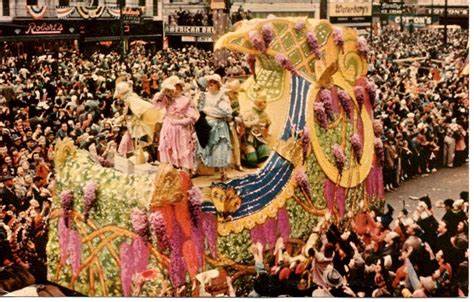
How did Mardi Gras come to the Mississippi Gulf Coast? While New Orleans and Mobile seem to garner more attention than our Coast Carnival season, it deserves its rightful place of distinction.
With the high anticipation of the Mardi Gras season upon us, I realized that I didn’t really know that much about how it came to the Gulf Coast. So for our historical piece this month, we will focus on the history of how Mardi Gras came to America, and more specifically, the Mississippi Gulf Coast. There’s always been a lot of history and mystery surrounding the origins of Mardi Gras in America, and we’re here to try to solve that.
Tracing its origins back to the French of the Bourbons, the tradition of Mardi Gras has its roots in 17th-century medieval Europe as a pagan celebration of spring and fertility, but the celebrations were often better known for decadence, debauchery, excessive drinking, and many unsavory acts. As Christianity rose in Rome, the church knew that it could not defeat the popularity of the Carnival season, so it sought to incorporate much of the tradition into the church, such as Lent and fasting.
When Mardi Gras made its way across the pond, it was first introduced not in New Orleans — the place that most people correlate with the holiday. Its roots have their beginning a bit further east along the coastline. Honestly, the birthplace of Mardi Gras and the city to hold its first parade is often a matter of contention and debate that has labored on throughout the years. A person’s stance on the issue usually is relative to where he or she is from. It’s almost as highly debated on the location of where the Blues were born.
A large consensus believes that Mobile is the birthplace of Mardi Gras, and the city is touted as having one of the oldest Mardi Gras celebrations tracing back to the 18th century. French settlers — mainly Roman Catholics — settled in the area and brought the traditions of Mardi Gras with them. In 1703, the very first Mardi Gras parade in America rolled through the tiny town of Fort Louis de la Mobile. At the time, Mobile was mainly a French community, and it would be about a century before Alabama was officially founded. Mobile holds the designation of being the home of the first mystic society or “krewe” that held Mardi Gras celebrations — about 14 years before New Orleans was even founded.
By the 1730s, Mardi Gras celebrations made their way to New Orleans, but it wouldn’t be until the late 1830s that the first Mardi Gras parade reportedly rolled through the streets of the Crescent City. The city held street processions of masked riders in carriages and on horseback. The flambeaux, which were dazzling gaslight torches, were carried by masked, costumed figures to light the path for the members of the krewes, bringing a bit of mystery, romance, and festivity to the proceedings. In 1856, the Mistick Krewe of Comus, a group of Mobile citizens, brought even more magic and mystery to the celebrations as magnificent floats rolled through the French Quarter. The second Krewe was founded in 1870 and was known as the Twelfth Night Revelers. This krewe holds the distinction of being the first group to begin treating fans with Mardi Gras “throws.”
The Mardi Gras celebrations continued to expand in New Orleans with vivid colors and costume designs by Carlotta Bonnecase, Charles Briton, and B.A. Wikstrom. Their ideas were brought to life by Georges Soulie, an acclaimed Parisian paper-mache artist. Soulie was regaled for his beautiful work as he continued to make the floats and costumes for New Orleans for about the next 40 years. In 1872, Rex, the King of Carnival, was created by a group of businessmen to proceed over the first parade held in the daytime. At that time, Russian Grand Duke Alexis Romanoff was visiting the area, and the Romanoff family colors of purple, green, and gold were incorporated as the official colors of Mardi Gras, a tradition that continues to this day. The next year, all floats were created in New Orleans and became even more ornate and exotic than ever before. In 1875, Governor Henry Warmouth signed the “Mardi Gras Act,” making Fat Tuesday a legal holiday in Louisiana.
As the celebrations of the Mardi Gras holiday and festivities expanded in popularity, it finally made its way to the Magnolia State, although others will debate that this is where the holiday originated — but we’ll get to that fact in a bit. The first Mardi Gras parade in Mississippi was held in Biloxi in 1908. It consisted of 17 floats, 150 torch carriers, and the royal monarchs presiding over events were named King d’Iberville and Queen Ixolib (Biloxi backwards). In 1916, a group was formed in Biloxi, calling itself the Biloxi Literary and Carnival Association but was changed to the Gulf Coast Carnival Association in 1946 — the name which it is still known by to this day. The association began hosting grand, lavish balls and parades across the city. The revelry soon spread to other areas along the Gulf Coast in 1929 as neighboring cities and towns began establishing their own Krewes while hosting their own parades and balls.
Here’s where the debate on the original location of the first Mardi Gras celebration comes in. This year will mark the 325th anniversary of the landing of the French-Canadian explorer team of Pierre Le Moyne d’Iberville and Sieur de Bienville landed on the peninsula of Biloxi. Why is that important?
It is believed that the concept of Mardi Gras officially arrived in North America on March 3, 1699, when the explorers landed at a spot 60 miles downriver from New Orleans, and d’Iberville proclaimed the landing spot as Point du Mardi Gras. As it was “Fat Tuesday” in d’Iberville’s homeland of France, he declared the spot Point du Mardi Gras and held a small gala to commemorate the event. Many consider this to be the first Mardi Gras to be held in America.
“It was on that voyage that he and his party commemorated Mardi Gras,” Anna Harris, executive director of the Coastal Mississippi Mardi Gras Museum said. “[‘Iberville] wrote in his ship’s log that ‘It is Mardi Gras day’ on March 3, 1699 — making him, as far as we know, the first reported person to celebrate Carnival in the Americas.”
In the 19th century, the French settlers in Mississippi began to officially celebrate Mardi Gras in an even grander fashion, and this year also marks the 116th anniversary of the Gulf Coast Carnival Association.
From the early beginnings of having about a dozen or so floats, the Mississippi Gulf Coast Carnival Association Parade now boasts over 100 floats and participants in its celebrations. And family and friends travel from around the globe to partake in the festivities. The Gulf Coast Mardi Gras celebrations are often more popular because of their more family-friendly, fun atmosphere, while still bringing the elegance and charm of old-world celebrations.
The tradition and history of Mississippi and Mardi Gras run deep, even though other cities often garner more attention or boast of being the first to celebrate this holiday. It doesn’t really matter to the revelers, ball attendees, and parade watchers. We all share the consensus that we are glad that these fun traditions and celebrations came to America and are still celebrated today.
But for those history buffs who might still quibble over the semantics of the origin of the Mardi Gras season, the Mississippi Gulf Coast has plenty to be proud of. Even though official Mardi Gras celebrations did not begin in Mississippi until 1908, Biloxi holds the distinction of being founded by the legend who brought Mardi Gras to America in 1699. The history of Mississippi and Mardi Gras are forever intertwined.
So now that this debate is somewhat settled, just go out there and have a grand time for Mardi Gras season only comes but once a year! Let the good times roll!
