



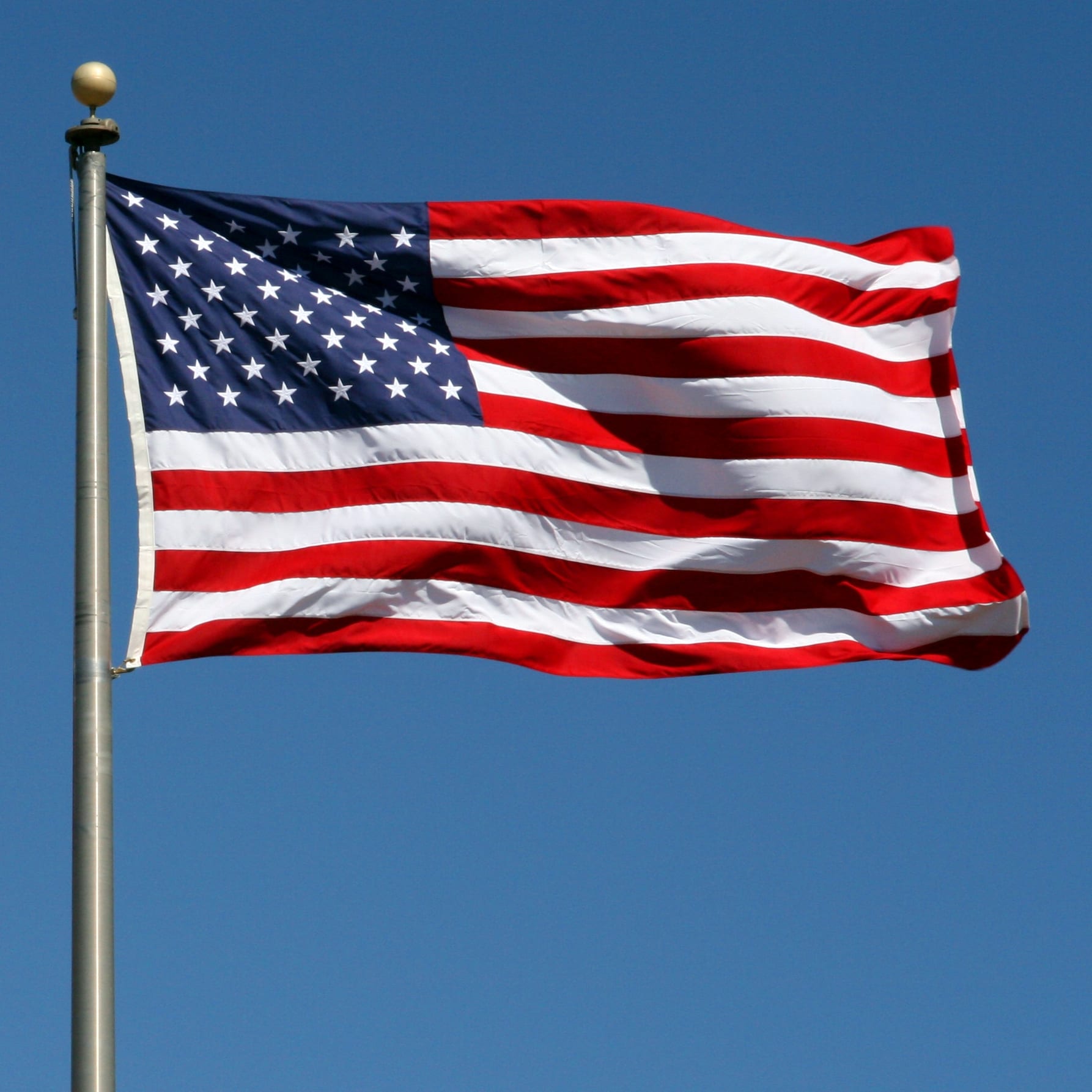
June 14 is Flag Day. It’s an annual observance of the Second Continental Congress’ official adoption of the American Flag in 1777, which at that time had only 13 stars. The holiday was officially established in 1916 by President Woodrow Wilson and in 1949 Congress declared June 14 a national holiday.
The current U.S. flag boasts 50 white stars on a field of blue and 13 alternating red and white stripes. The stars represent each of the 50 states and the stripes the original 13 colonies. The flag itself is synonymous with freedom and independence.
Flag Day isn’t a federal holiday but it is observed all over the country. People proudly display the flag at homes and public buildings and some locations have street parades.
Here are 25 facts about the U.S. flag:
- The first “official” American flag was created in June 1775. It was known as the Continental Colors or the Grand Union Flag, and much like today’s flag, it was comprised of 13 red and white alternating stripes to represent the 13 original colonies. But it also included a Union Jack in the corner and that was a problem for a nation fighting to be free from British rule. The Second Continental Congress wanted a flag different than the British one, so on June 14, 1777, the Congress decided on a flag with alternating red and white stripes and 13 stars in a blue field. Since then, the flag has changed 27 times to accommodate the addition of new stars every time a state was admitted to the Union, culminating into the current flag consisting of 50 white stars.
- The colors of the flag have meaning. Red stands for hardiness and valor. White symbolizes purity and innocence. And blue represents vigilance, perseverance and justice.
- The American flag has three nicknames – “the Stars and Stripes,” “Old Glory,” and “the Star-Spangled Banner.”
- Many songs pay tribute to the U.S. flag, but the two most popular are our national anthem, “The Star-Spangled Banner” and “You’re a Grand Old Flag.”
- There is much debate over who actually designed and created the first U.S. flag. Betsy Ross is credited with sewing the first flag (which is perhaps why the U.S. flag flies 24/7 at her home in Philadelphia), but some historians say the flag was designed by Francis Hopkinson, a signer of the Declaration of Independence. Ross was a seamstress who assisted the Revolutionary War effort by repairing uniforms and sewing tents, so it’s only natural to believe she could have also sewn the first American flag. Only there is no historical evidence that that happened. In fact, it wasn’t even until nearly a century later, in 1870, when her grandson, William Canby, told Ross’ story to the Historical Society of Pennsylvania that the public learned of her possible role. So did she or didn’t she? Even though there is no proof she did, there is also no proof that she didn’t.
- The flag is usually flown from sunrise to sunset. It should not be flown at night without a light on it.
- 50 U.S. flags fly 24/7 at the Washington monument in Washington, D.C.
- There are also ten other locations where flying the flag around the clock is permissible. They are the Betsy Ross House in Philadelphia; the White House; the U.S. Capitol; the Iwo Jima Memorial to U.S. Marines in Arlington, Virginia; the Revolutionary War battleground in Lexington, Massachusetts; the site of George Washington’s winter encampment at Valley Forge, Pennsylvania; Fort McHenry in Baltimore, Maryland; the Jenny Wade House in Gettysburg, Pennsylvania (Jenny Wade was the only civilian killed in the Battle of Gettysburg during the Civil War); the USS Arizona Memorial at Pearl Harbor, Hawaii; all customs points of entry into the United States; and any U.S. Navy ship that is underway.
- The flag should not be flown in the rain or inclement weather.
- The flag should never be flown when it’s old or torn. Old flags should be disposed of in a dignified manner, either by burning or burial.
- An American flag should never touch the floor, ground or water. If it does, it must be cleaned and inspected for damage. If it’s clean and undamaged, it can continue to be flown.
- When the U.S. flag is raised on a flagpole, it must be raised quickly. When it’s lowered, it is raised slowly. It’s raised quickly so as to give the impression that the flag is eager to get to the top of the pole and represent the nation. It’s lowered slowly to give the impression that it’s reluctant to leave its post.
- After a tragedy or death, the flag is flown at half-staff for 30 days. On land it’s called “half-staff” and on a ship it’s called “half-mast.” Flying a flag at half-staff or half-mast is a symbol of grief and mourning. The President, as well as the governor of any state, can order that flags be flown at half-staff at any time during the year and for any length of time. To fly a flag at half-staff or half-mast, the flag is raised quickly to the top and then slowly lowered to half-staff or half-mast.
There are certain commemorative days when it is customary to lower the flag to half-staff:
- Peace Officers Memorial Day (May 15, unless that day is also Armed Forces Day)
- Memorial Day (last Monday in May, from sunrise to noon)
- Patriot Day (Sept. 11)
- National Firefighters Memorial Day (October)
- Pearl Harbor Remembrance Day (Dec. 7)
- Whenever the flag is displayed on a wall or window the blue field should be in the upper left corner.
- In the military, after the flag is lowered or after a military funeral, it’s folded with 13 folds, each fold having symbolic meaning.
- The U.S. flag always flies at the top of a staff above any other flag. When the flags of cities, states, localities or groups are flown on the same staff as the American flag, the U.S. flag should always be at the peak. When flags of two or more nations are displayed, they should be of equivalent size and flown from separate staffs of the same height
- According to the U.S. Flag Code, whoever knowingly destroys the American flag shall be fined or imprisoned for not more than one year, or both. Obviously, this doesn’t pertain to the respectful disposal of a worn or soiled flag.
- Unlike intentionally destroying an intact U.S. flag, flying one upside-down is not always intended as an act of protest. According to the U.S. Flag Code, it can also be an official distress signal.
- The U.S. Flag Code bans the use of an actual American flag as any type of clothing, however, it’s not illegal to wear clothing depicting the U.S. flag.
- The practice of draping coffins in the American flag is not reserved for military veterans and government officials. On the contrary, any burial may incorporate this tradition.
- A vexillogist is someone who studies flags.
- There are 6 American flags on the moon planted by the Apollo astronauts (Apollo 11, 12, 14, 15, 16 and 16).
- Pennsylvania is the only state that observes Flag Day as a state holiday.
- The idea for a flag day was invented by a teacher in Wisconsin. On June 14, 1885, Bernard J. CiGrand, who was only 19-years-old, led his school in the first formal observance of the holiday. Sixty-four years later, in 1949, Congress declared June 14 a national holiday.
- A teenager designed the current American flag. In 1958, when it seemed certain that Alaska would be admitted to the Union, designers began redesigning the flag to add a 49th star. Then-17-year-old Robert G. Heft of Lancaster, Ohio, in thinking that Hawaii would soon also be admitted as a state, reconfigured his family’s 48-star flag to account for two additional stars. Heft turned in his creation for a school history project, for which he received a grade of a B-. Heft also sent it to his congressman, Walter Moeller, who presented it to President Eisenhower after both states joined the Union. Eisenhower selected Heft’s design and on July 4, 1960, President Eisenhower and Heft watched together as the 50-star flag was raised for the first time. Heft’s teacher promptly changed his grade from a B- to an A.
So this year on Flag Day, now that you know a few facts about the U.S. flag, you’ll know why you’re celebrating and you can impress your family and friends with these fact
