


Skip to content
Close Menu

    Subscribe to Updates

    Get the latest creative news from FooBar about art, design and business.

    Most Viewed

    The Old Farmer’s Almanac Has Spoken on Mississippi’s Fall Forecast

    July 25, 2025

    Old Sayings Say It Best

    May 22, 2024

    Actor Jeremy London Calls Mississippi Home

    August 1, 2024

    The Julep Room: A Hole in the Wall with History

    January 8, 2024
    Facebook X (Twitter) Instagram
    Tuesday, February 10, 2026
    Trending
    • A Hattiesburg Mom Turned a Children’s Book Into a Lifeline for a Family Waiting on a Heart
    • Super Sub Mr. B. Celebrates 20 Years in the Classrooms
    • Shipley’s vs. Dunkin’: A Mississippi Girl’s Boston Reality Check
    • From Coast Classics to Your Kitchen: Pizza Spots & Homemade Tips
    • Crazy B’s King Cakes and Bites are a Local Favorite
    Facebook X (Twitter) Instagram YouTube TikTok
    Login
    Our Mississippi HomeOur Mississippi Home
    • Living

      Shipley’s vs. Dunkin’: A Mississippi Girl’s Boston Reality Check

      February 10, 2026

      Crazy B’s King Cakes and Bites are a Local Favorite

      February 9, 2026

      Krewe of Gilles Crowns Royalty in Endless Summer Ball

      February 6, 2026

      A Place to Splash, Learn, and Belong: A Community Vision Taking Shape in Tylertown

      February 6, 2026

      A Forecast of Baseball

      February 5, 2026
    • Arts / Culture

      Theatre MSU Brings the Heat, Razor-Sharp Wit to 2026 Season

      February 5, 2026

      Southern Miss Connoisseurs Series Features World-Class Artists in Free Concerts

      January 28, 2026

      MSU Riley Center Unveils 2026 Spring/Summer Performing Arts Series

      January 23, 2026

      Southern Miss School of Music Welcomes Community to Two Free Concert Showcases in February

      January 22, 2026

      “The Ball” Continues to Stand Alone Among Carnival Events

      January 22, 2026
    • Entertainment

      WMSV The Junction Listeners ‘Rise and Ring’ With On-Air Bulldog Talent

      January 29, 2026

      Where Faith, Family, and Music Meet: Shay and Michi Guess of Mantachie

      January 14, 2026

      From Hawkins to the Coast: Stranger Things Finale Comes to Mississippi

      December 16, 2025

      Love in the Layover: A Holiday Story Rooted in Connection

      December 1, 2025

      Pascagoula Celebrates Alien Abduction Legend

      October 7, 2025
    • Food & Dining

      From Coast Classics to Your Kitchen: Pizza Spots & Homemade Tips

      February 9, 2026

      Exploring the Coast, One Bite at a Time

      February 2, 2026

      A Coastal Favorite for Coffee, Conversation, and Comfort Food

      January 25, 2026

      Ole Miss Football Victory Tastes Like Chicken

      December 29, 2025

      Leftovers With Style: Turning Holiday Extras Into Inspired Meals

      December 28, 2025
    • Environment

      Great Horned Owls – So Many Cool Facts

      February 7, 2026

      Watching Birds That Flock Together in Winter

      January 31, 2026

      The Gift of Wetlands – Tidal Marshes

      January 24, 2026

      We’ve Been Here Before: Remembering Mississippi’s Ice Storm of 1994 as Winter Weather Returns

      January 22, 2026

      Winter Tides

      January 17, 2026
    • Lagniappe
      • Business
      • Sports
      • Education
      • Health & Wellness
      • OurMSVoices
      • People
    Subscribe
    Our Mississippi HomeOur Mississippi Home
    Home»Environment»Berries That Feed Birds in Winter
    Environment

    Berries That Feed Birds in Winter

    Mark W. LaSalle, Ph.D.By Mark W. LaSalle, Ph.D.February 2, 20193 Mins Read10 Views
    Share Facebook Twitter Pinterest LinkedIn Tumblr Reddit Telegram Email
    Share
    Facebook Twitter LinkedIn Pinterest Email Copy Link

    Berries are important sources of nutrition for many birds, especially in winter when other sources of food are less abundant. For the plants, birds help transport seeds and prepare them for germination by their passage through the bird’s digestive track. Understanding this link between berries and birds is all about what each party gains from the partnership. The nutritional value in a berry is in the fleshy tissue that surrounds one or more hard-coated seeds. Most birds simply swallow seeds whole and the hard coating protects the embryo within the seed as it passes through the gut. The fleshy portion of the berry is rich in carbohydrates and lipids (fat) that fuel metabolism in cooler weather. There is evidence that the passage of seeds through the guts of birds acts to scarify (etched by acids) and soften the hard coating, making germination more likely if the seed is deposited in a suitable place. So, the timing of ripened berries in late winter and the presence of winter birds that eat them is no accident. This is how evolution works in animal-plant dependent relationships.

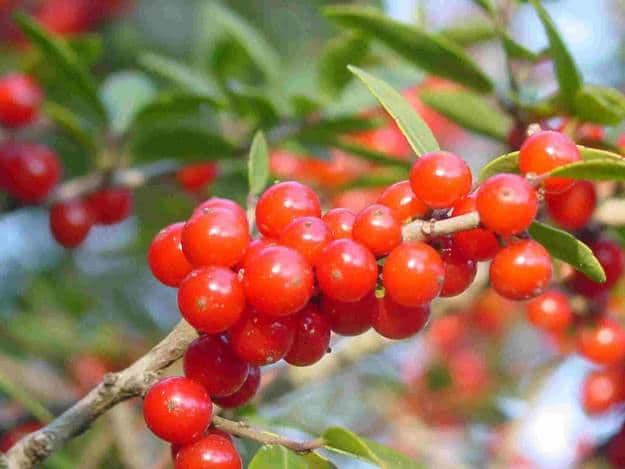
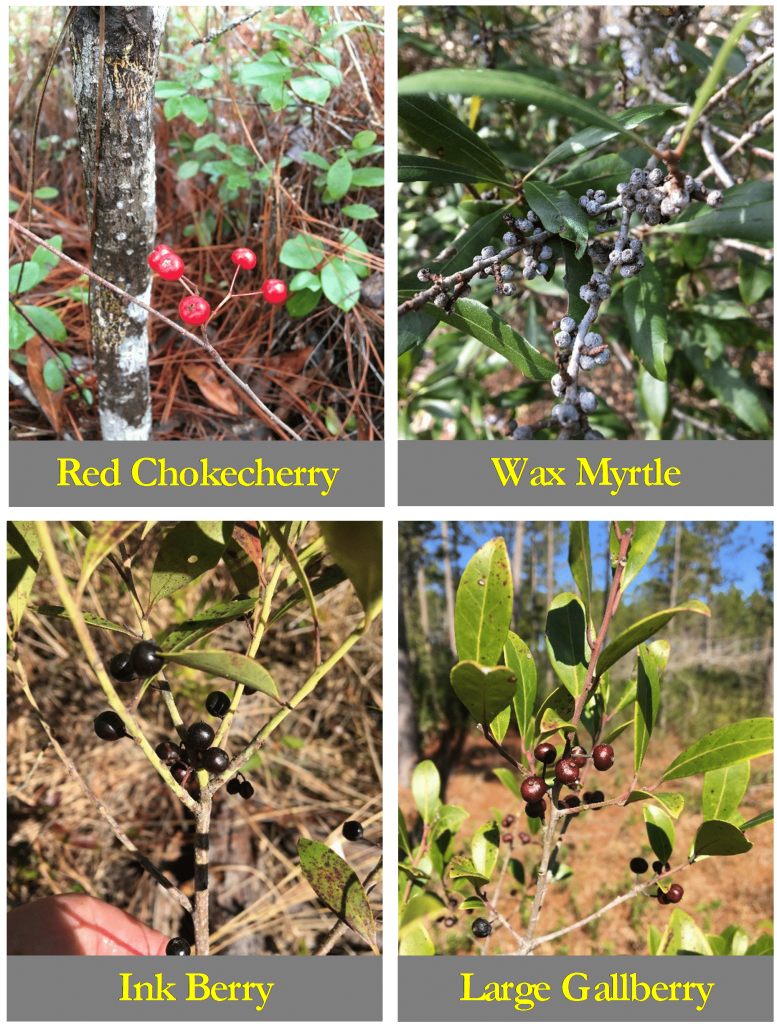
    Other examples include insects and birds that pollinate plants at certain times of the year. In south Mississippi, there are a number of commonly occurring berry-producing plants that feed birds in winter, with one group especially dedicated to this strategy – hollies. By far the most common of this group is Yaupon (Ilex vomitoria) with its shiny, bright red berries that are hard to miss in the landscape. And yet, the blue to reddish-blue berries of Inkberry (Ilex glabra) and Large Gallberry (Ilex coriacea) are also common, if you know where to find them. Not to be outdone, however, is Wax Myrtle (Morella cerifera) that produces an abundance of blue/white coated hard berries that are also relished by many wintering birds. The waxy coating is rich in lipids. But if you look around, other winter blue and red-berried plants are also depending on birds to spread their seeds. One example is Red Chokecherry (Aronia arbutifolia), with its prominent red berries. Of these examples, the two that standout in most or our backyards are Yaupon and Wax Myrtle.
    winter berries

    But you may have already noticed that not all individual plants of these species will produce berries, because all of the hollies and Wax Myrtles are dioecious – referring to a species having male and female parts on separate plants. Yes, this term is based in Latin and Greek, with the root “oecious” meaning “house” and the prefix “di” meaning two. Female plants produce berries from “pistillate” flowers (the female part of flowers) while male plants produce pollen from “staminate” flowers (the male component).

    As for the birds that we most often see using winter berries, think of American Robins or Cedar Waxwings that descend upon your local Yaupon or American Holly (Ilex opaca) trees and devour them with gusto, and then fly over and deposit the expelled berry “pieces and parts” on the roof and hood of your car! Yellow-rump Warblers and Tree Sparrows are two other common winter species that relish the berries of Wax Myrtle. Apart from their value in feeding birds in winter, these berry-producing plants are also great native plant choices for your landscape, providing places for birds to nest and roost.

    Look for these important plants on your winter walks in your neighborhood or on the many nature trails across the coast. Consider this my “Winter Berry Scavenger Hunt” challenge.

    Hope to see you in OUR great outdoors!!!

    birds winter berries
    Previous ArticleA Penny War at RCES Teaches Students Life Lessons
    Next Article Embracing a Sleeping Giant – Through the Art of Carmen Lugo
    Mark W. LaSalle, Ph.D.

    Mark is a naturalist and wetland ecologist, providing expertise on wetlands, water quality and environmental impacts of humans. He has also developed and conducted a number of environmental education programs and workshops for youth, teachers, realtors, and the general public on a variety of subjects including wetlands, natural history, and environmental landscaping. Mark is a graduate of the University of Southwestern Louisiana (B.S. and M.S. degrees) and Mississippi State University (Ph.D.). Mark is the recipient of the Chevron Conservation Award, the Mississippi Wildlife Federation Conservation Educator Award, the Gulf Guardian Award, and the Boy Scouts of America Silver Beaver Award.

    Related Posts

    Qu’est Que C’est

    Great Horned Owls – So Many Cool Facts

    February 7, 2026
    Qu’est Que C’est

    Watching Birds That Flock Together in Winter

    January 31, 2026
    Qu’est Que C’est

    The Gift of Wetlands – Tidal Marshes

    January 24, 2026
    Add A Comment

    Comments are closed.

    Stay In Touch
    • Facebook
    • YouTube
    • TikTok
    • Twitter
    • Instagram

    Subscribe to Updates

    Get the latest good news happening in Mississippi!

    Most Popular

    The Old Farmer’s Almanac Has Spoken on Mississippi’s Fall Forecast

    July 25, 20258K Views

    Old Sayings Say It Best

    May 22, 20247K Views

    Actor Jeremy London Calls Mississippi Home

    August 1, 20247K Views
    Our Picks

    A Hattiesburg Mom Turned a Children’s Book Into a Lifeline for a Family Waiting on a Heart

    February 10, 2026

    Super Sub Mr. B. Celebrates 20 Years in the Classrooms

    February 10, 2026

    Shipley’s vs. Dunkin’: A Mississippi Girl’s Boston Reality Check

    February 10, 2026

    Subscribe to Updates

    Get the latest good news from Our Mississippi Home.

    Our Mississippi Home
    Facebook X (Twitter) Instagram YouTube TikTok RSS
    • About OurMSHome
    • Advertise
    • Community Partners
    • Privacy Policy
    • Guidelines
    • Terms
    © 2026 Our Mississippi Home. Designed by Know_Name.

    Type above and press Enter to search. Press Esc to cancel.

    Ad Blocker Enabled!
    Ad Blocker Enabled!
    Our website is made possible by displaying online advertisements to our visitors. Please support us by disabling your Ad Blocker.

    Sign In or Register

    Welcome Back!

    Login to your account below.

    Lost password?