



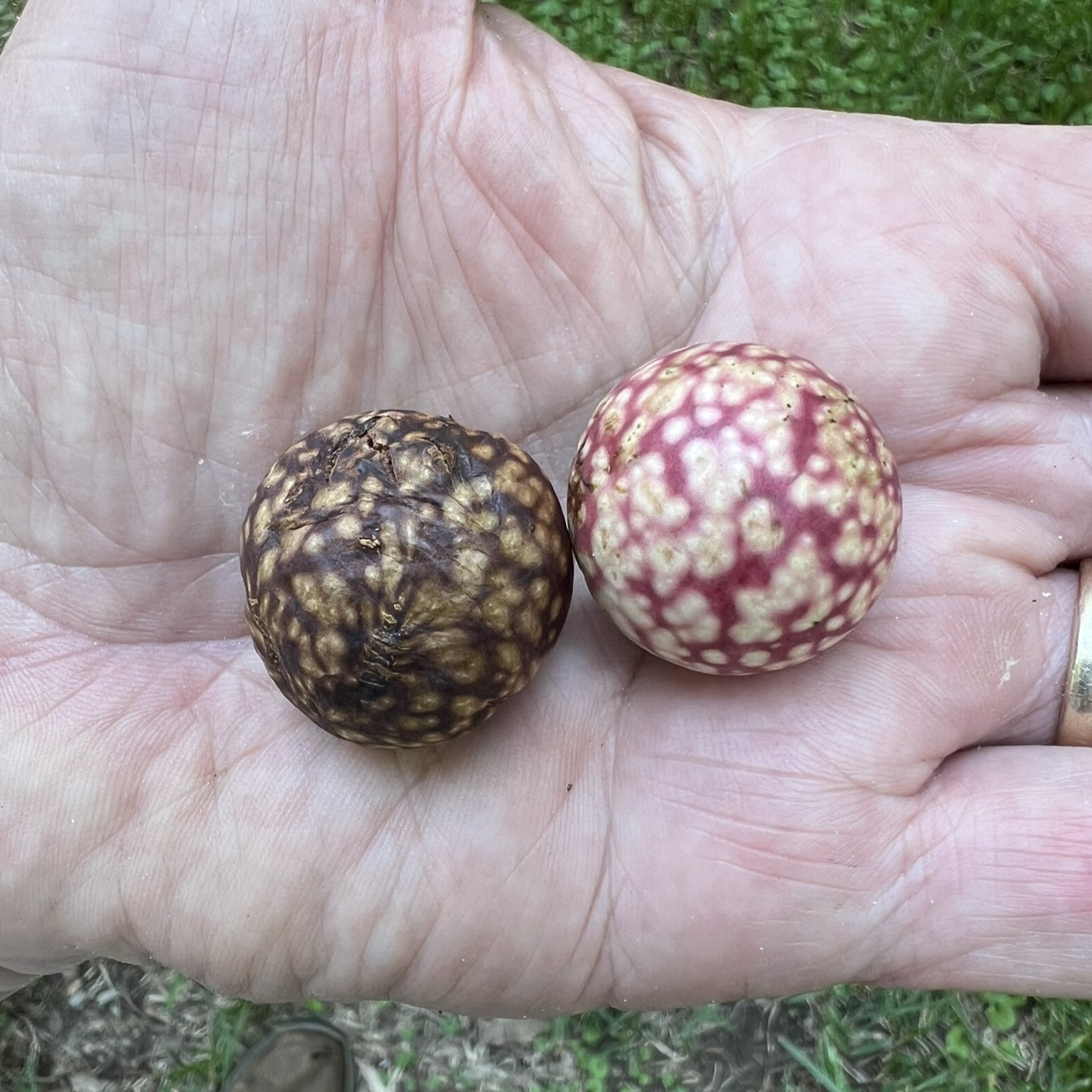
As a child, I was intrigued when I found perfectly round balls under the trees in the woods that I wandered through. Sometimes they were smooth and red-speckled. Other times they were brown and wrinkled. They looked like what I imagined a brain might appear to be without a skull, so brain balls they became. I had no clue how they came to be. But these galls are only part of a larger story about the insects that cause them to form on oaks.
As the common name suggest, these round balls resemble plums when they appear in late spring, round, smooth and red. Most are securely attached to the caps or petioles of acorns attached high in the trees. Only when the wind or a critter dislodges them do they fall to the ground, where a curious child can find them. They are found primarily on Northern or Southern Red Oaks and are created in reaction to the Acorn Plum Gall Wasps, Amphilbolips quercusjuglans, one of many species of tiny wasp in the gall-forming family Cynipidae.
Humans are familiar with larger wasps that can sting their prey and us. But there are far more species of wasp that go unnoticed because of their size and lifestyles, like the gall wasps that do not sting, but rather use their ovipositor to lay their eggs. In most cases, the reaction to the insertion of an egg into the host plant tissue causes the galls to form. The galls themselves are distinctive for each species. For the Acorn Plum Gall Wasp, it appears to be the feeding action of a larval stage of a much more complex life cycle, one that goes through what is known as alternation of generations, one with sexually active males and females and another with only asexual females.
If we start with the galls, each supports the development of a sexual male or female wasp, tucked within a small central chamber in the larger structure, where it is relatively safe from predators or parasites (other wasps). Once fully developed, in late summer or early fall, the wasps emerge from the galls and seek out mates. Fertilized females fly to the ground, burrow into the soil, and deposit their eggs on the small fine roots of the host tree.
 The first generation larvae hatch in the spring and feed on the roots. They metamorphize into wingless asexual females that crawl up the tree, where they lay eggs on the caps or twigs of developing acorns, one per acorn. It is the second generation larvae that live in the galls. When you consider the height of a mature Red Oak, that is a long journey for such a small insect. The trunks of trees are the link between the soil and the acorns above.
So, as with many pieces and parts of nature that we encounter, there is always a larger story. In this case, those red-speckled balls that we find under our Red Oaks represent but one part of that story for one of many tiny wasps that inhabit our world and go largely unnoticed by us.
Hope to see you in our great outdoors!
