



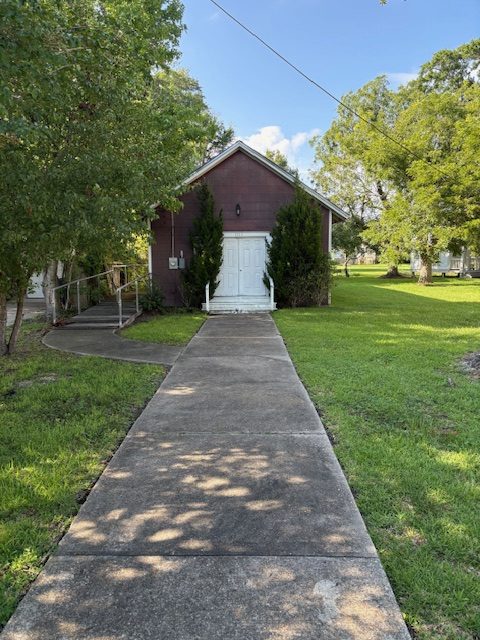
On the western end of Washington Avenue in Pascagoula, there is a quiet, shaded, unpretentious property which has played an important role in the history of the coastal city. Indeed, the plot of land has housed activity that has helped mold Pascagoula as we know it today.
- In 1875, Mary Dodson Hendrickson deeded the property at what is now 1111 Washington Avenue to be used for a school. Thus, Beach Elementary School had its beginnings in an 800 square foot building originally constructed of lapped boarding. The first classes had 36 pupils, grades one through five (later to become on through six). The first teachers were mesdames Sutton, Laurendine (two), and Krebs. The building served as the area’s elementary school until it moved a few blocks east on Washington Avenue in 1904.
This move was partly precipitated by the towns of Pascagoula and Scranton merging into one city- to be named Pascagoula- that year. This building was home to Beach Elementary until 1944. The structure still stands at 1315 Washington Avenue, and is now a private residence.

In 1944, Beach Elementary School opened at its present site on the northwest corner of Washington Avenue and Market Street. Through the intervening 82 years, Beach has prospered as one of the most highly thought of elementary schools in the area, even being ranked as the second highest ranked grade school in the entire state of Mississippi in 2024.
- When Beach Elementary moved down the street to its second location in 1904, the property at 1111 Washington Avenue did not lie fallow. From 1902 onward for many years, the little red building was used as the Beach Voting Precinct. Therefore, countless elections—national, state, and local—were decided with the help of Pascagoula citizens casting their ballots in the historic facility.
Then, in 1909, the Pascagoula Hose Company, merging with the Scranton Volunteer Fire Company, moved into the building. From that point until 1924, the facility housed the principal firefighting and protection service for the southernmost part of Pascagoula. The following passage from 1909, written to introduce the new fire station, is quite descriptive and instructive: “The purpose for which it is created is: -To organize and maintain a volunteer Fire Company without capital stock, and to some without pay in extinguishing fires in the southern portion of the City of Pascagoula, to organize and train the ‘fire laddies’ to fight the demon of fire, that terrible enemy who springs full panoplied from the head of a Lucifer match in the ‘stilly’ hours of night, assumes the forms of conflagration in a twinkling, the mien of an avenging Nemesis, and with a crackle and roar of ten thousand devils strikes terror to the heart of a slumbering populace.” (Man, those folks could put out the prose back in the day. I definitely miss seeing some of that flowery language now and then.)
The building served as somewhat of a multi-use facility from 1924-1945.A prime example was housing meetings of and events for the State Conservation Commission and the Democratic Executive Board. Then, from 1945-1951, the Pascagoula Garden Club held its meetings there.
- The year 1950 marked a milestone for the property at 1111 Washington Avenue in Pascagoula. It was at this time that the facility became the home of the Anola Club of Pascagoula.
The Anola Club has been a pillar of the Pascagoula Community since 1943, when it was organized at a meeting on the porch of the historic Old Place on the banks of the West Pascagoula River. It is a women’s service organization that has truly made a difference in the lives of local citizens.

Here is just a sampling of the projects that the Anola Club has created and fostered over the 83 years of its existence:
= Founded the Singing River Hospital Auxiliary, which contributes greatly to the hospital’s mission, as well as the Candy Striper program for youth there.
= Began the Red Cross Gray Ladies program in local schools.
= Conducted baby-sitting programs to train interested individuals.
= Provides valuable scholarships, worth hundreds of thousands of dollars and counting, to deserving local high school and middle school students.
= Assisted with needs for the Jackson County Animal Shelter.
= Participates in many local fund-raising efforts for worthy causes, including the La Pointe-Krebs Home, the Salvation Army, and many others.
The membership of the Anola Club over the years reads like a virtual “who’s who” of Pascagoula community leaders. A significant portion of the residents of the city have had their lives affected positively by the Anola Club.
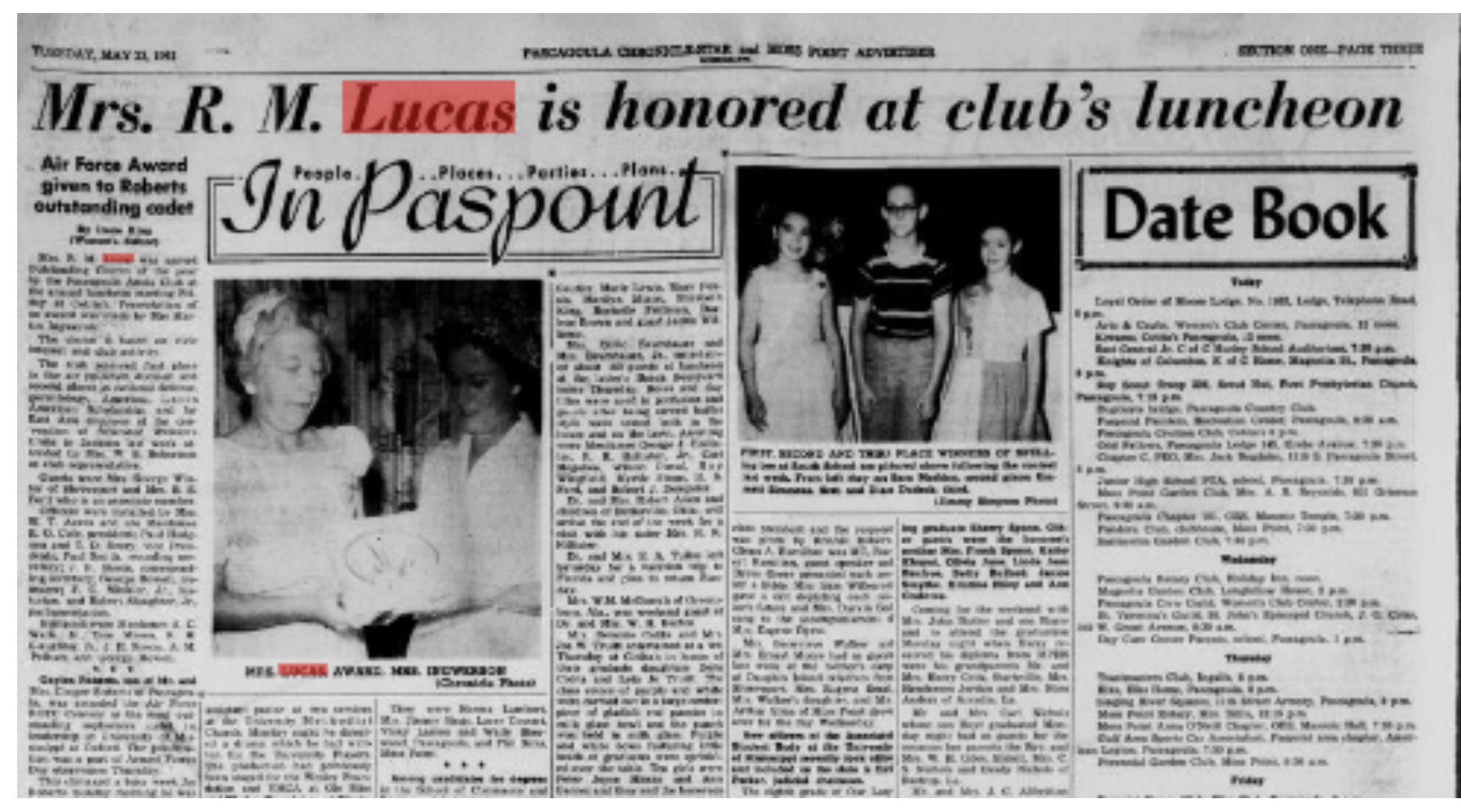
Here, I must put in a point of personal pride. Pascagoula Historic Preservation Commission Chairman Barry McIlwain, who did an excellent job of helping me do research for this column, came across a story in the May 21, 1961, edition of the Chronicle-Star, Pascagoula’s newspaper at the time. A banner headline across the top of the page read “Mrs. R. M. Lucas honored at club’s luncheon”. (Just a little dated on the nomenclature there.) My mother, one of the first Anola Club members, had been named as Outstanding Citizen of the Year. A photo showed the award being presented to her by “Mrs. Martin Ingwersen”, who was my good and great friend Dick Ingwersen’s mother. My mom had served as Anola Club president in 1951-52 , and my wife Mary Jon followed in her footsteps a few decades later. Seeing that story about my mother from when I would have been 12 years old created a warm and beautiful memory for me.
So, the history of the little building at 1111 Washington Avenue in Pascagoula has been long (151 years) and colorful, and has witnessed many iterations: school house, fire house, meeting house, and club house. Through it all, what started as Beach Elementary School and is now the Anola Club has maintained a very important hallmark of continuity. This pleasant, diminutive structure has always been a center of positivity, activity, and productivity. Today’s Anola Club building is truly a Pascagoula icon.
Richard Lucas may be reached at [email protected].
