



Skip to content
Close Menu

    Subscribe to Updates

    Get the latest creative news from FooBar about art, design and business.

    Most Viewed

    The Old Farmer’s Almanac Has Spoken on Mississippi’s Fall Forecast

    July 25, 2025

    Old Sayings Say It Best

    May 22, 2024

    Actor Jeremy London Calls Mississippi Home

    August 1, 2024

    The Julep Room: A Hole in the Wall with History

    January 8, 2024
    Facebook X (Twitter) Instagram
    Monday, January 5, 2026
    Trending
    • Find Your Next Library Event This January!
    • Landscaping for Hummingbirds
    • Why Lentil Vegetable Soup Is the Perfect Post-Holiday Reset
    • Fiesta Time: Football Advances to CFP Semifinals With Win Over Georgia
    • Turning Pages in Summit: Buzy Beez Bookstore
    Facebook X (Twitter) Instagram YouTube TikTok
    Login
    Our Mississippi HomeOur Mississippi Home
    • Living

      Unique Ways Mississippi Celebrates the New Year 

      December 30, 2025

      Catfish, Crappie & a Countdown: How Mississippi Rings in the New Year

      December 29, 2025

      Ole Miss Football Victory Tastes Like Chicken

      December 29, 2025

      What’s Your Favorite Christmas Tradition?

      December 24, 2025

      The Gift of Mississippi

      December 24, 2025
    • Arts / Culture

      Clinton Native Makes His Mark: Jacob Dillard Debuts at the Grand Ole Opry

      December 26, 2025

      Mississippi Museum of Art to Present First Major Museum Exhibition of the Art and Singular World of L.V. Hull, Coinciding with Opening of the L.V. Hull Legacy Center

      December 18, 2025

      Designing Success: Southern Miss Graphic Design Program Gains National Momentum

      December 3, 2025

      Mississippi Museum of Art Presents First Major Survey of Quilt-Works by Coulter Fussell

      December 2, 2025

      Love in the Layover: A Holiday Story Rooted in Connection

      December 1, 2025
    • Entertainment

      From Hawkins to the Coast: Stranger Things Finale Comes to Mississippi

      December 16, 2025

      Love in the Layover: A Holiday Story Rooted in Connection

      December 1, 2025

      Pascagoula Celebrates Alien Abduction Legend

      October 7, 2025

      Coastal Towns Prepare to Welcome Cruisers

      October 3, 2025

      Zonta Festival Returns: A Downtown Pascagoula Tradition Since 1977

      October 2, 2025
    • Food & Dining

      Ole Miss Football Victory Tastes Like Chicken

      December 29, 2025

      Leftovers With Style: Turning Holiday Extras Into Inspired Meals

      December 28, 2025

      A Potluck Favorite: Simple Jambalaya for Chilly Days

      December 14, 2025

      Jackson Named the South’s Top Culinary Town for 2025

      December 9, 2025

      From Vardaman Sweet Potatoes to Cajun Rice: One Southerner’s Kitchen Evolution

      December 8, 2025
    • Environment

      Landscaping for Hummingbirds

      January 3, 2026

      A Season for Stewardship: Simple Winter Conservation Actions for Mississippi Families

      December 20, 2025

      Southern Miss One of Five Institutions to Receive NOAA Funding for Long-Term Research in the Gulf

      December 19, 2025

      Become a Winter “Hummer Host”

      December 15, 2025

      Learning to Love Greenbriers

      December 13, 2025
    • Lagniappe
      • Business
      • Sports
      • Education
      • Health & Wellness
      • OurMSVoices
      • People
    Subscribe
    Our Mississippi HomeOur Mississippi Home
    Home»Environment»Qu’est Que C’est»Learning to Love Greenbriers
    Qu’est Que C’est

    Learning to Love Greenbriers

    Mark W. LaSalle, Ph.D.By Mark W. LaSalle, Ph.D.December 13, 20254 Mins Read17 Views
    Share Facebook Twitter Pinterest LinkedIn Tumblr Reddit Telegram Email
    u89-Smilax-auriculata-adjusted-1
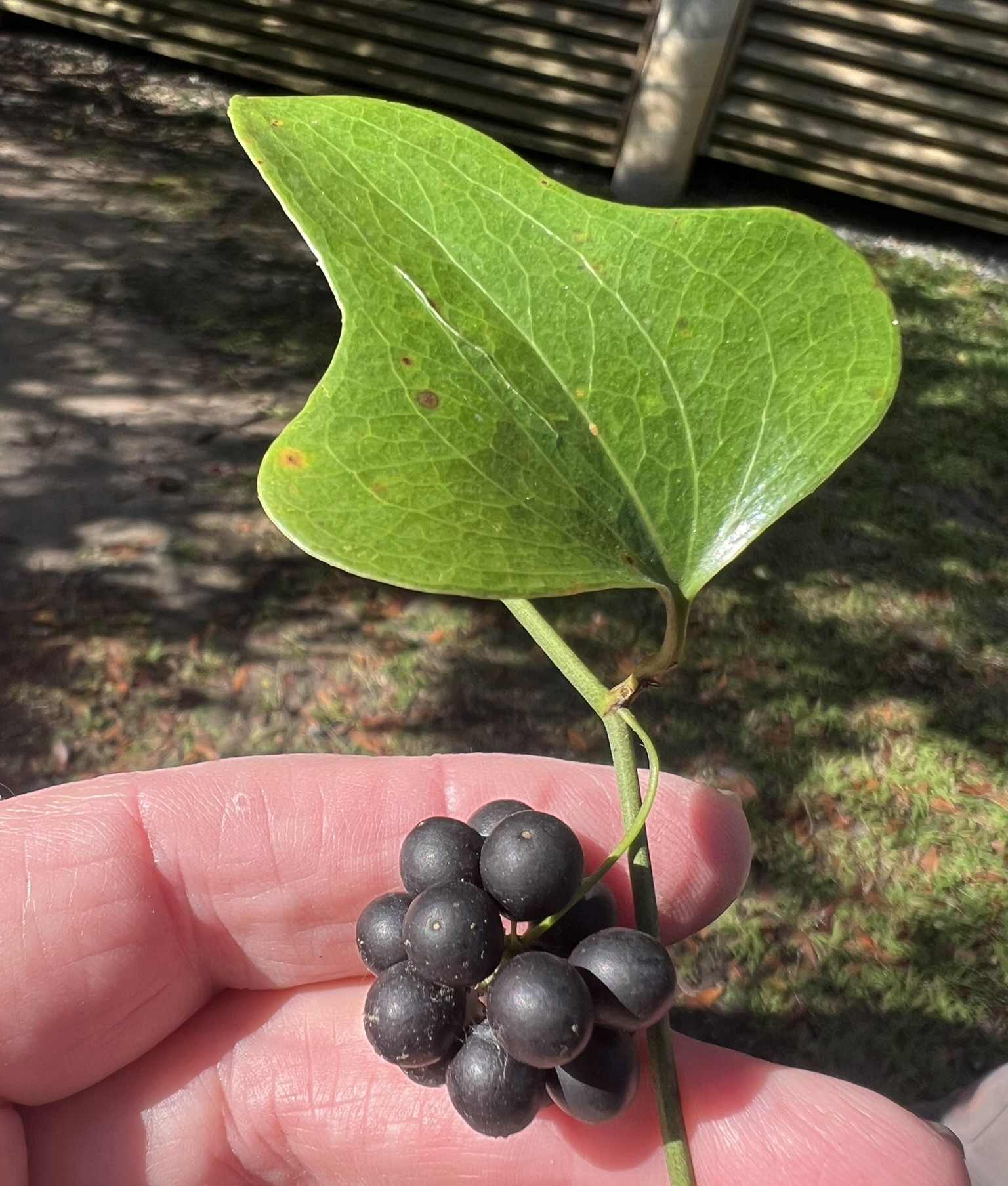
    Earleaf Greenbrier
    Share
    Facebook Twitter LinkedIn Pinterest Email Copy Link

    Of all the vines in natural landscapes across the south, greenbriers are the most memorable, but not typically for good reasons. Also known as catbriers, these tough vines sport some of the nastiest thorns of any plant. And yes, they hurt! I have scars, and many stories about how they have entrapped, tripped, made me bleed, and use words that my Mama did not like me to say. But bear with me as I try to mitigate their reputation.

    Yes, most of the nine species in the genus Smilax found in the southeastern U.S. have thorns along their stems: one species with spines on the margins of their leaves and main leaf veins, to add insult to injury. Greenbriers are common across dry and wet habitats. Vines grow out of large, hard, underground tubers that can form dense beds that are difficult to remove.

    And this is not the first time I have written about at least some of these plants. My previous story was focused on how great some taste as a wild edible plant when their canes are just emerging in the springs https://ourmshome.com/eating-greenbriers-before-they-eat-you/ Besides being edible, there are a couple of redeemable qualities of these plants, even for humans.
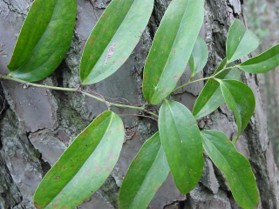
    Smilax smallii is commonly called Jackson Vine and was used as a decorative element in southern homes dating before and during the Civil War. The small, dark green, and narrow leaves of this plant are attractive, and the stems have few if any thorns. Allegedly, these vines were used to adorn tables and doorways, when General Stonewall Jackson visited homes during the war – thus the common name, although the story is suspicious. This species was also apparently found as part of the landscaping of southern homes during these periods
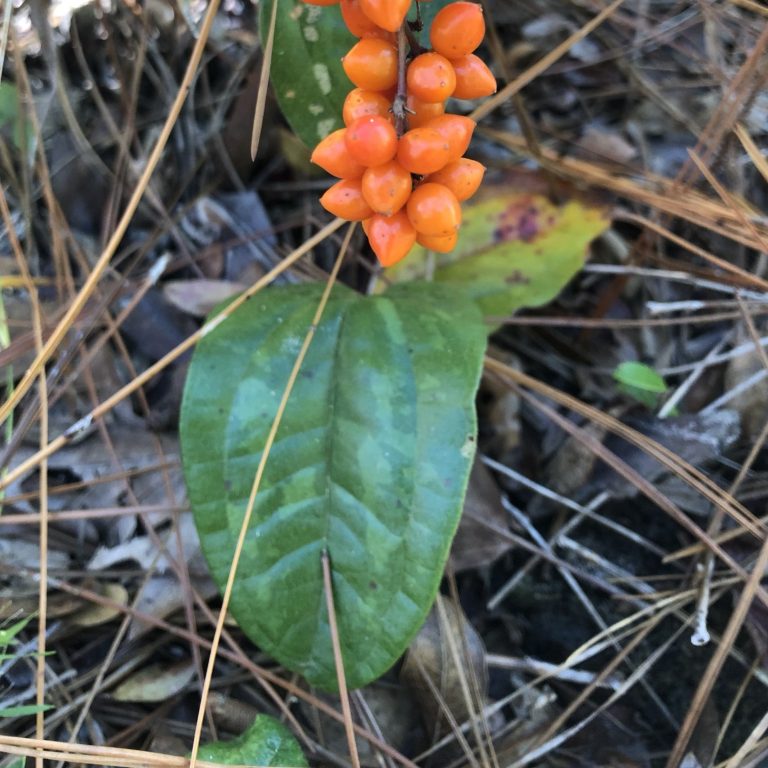
    Similarly, Smilax pumila or Sarsaparilla Vine is thornless, evergreen, with large, often variegated leaves – dark green with light green patches. This ground-hugging vine is found in dry pinelands and is often used to adorn door wreaths. It is the only species with clusters of bright orange fruit. It would make a nice ground cover in any home situation.

    My favorite thing about these plants is that their young canes and leaves are edible and delicious, raw or cooked as you would with any green. Apart from being tasty as young stems, the hard tubers can be processed into starch-rich powders that native Americans used as a thickener in cooking, and when mix with honey, as a special treat. These plants also had numerous medicinal uses for indigenous people.

    And least we leave out the value of these plants for wildlife, as nibble for many furry herbivores, and tasty meals as fruit for small mammals and birds. But as with any dioecious species (separate male and female plants), only the female vines bear fruit. All but Sarsaparilla vine and Coral Greenbrier have dark blue to black fruit: Coral Greenbrier fruit are red. Other species include Earleaf Greenbrier (Smilax auriculata), Wild Sarsaparilla (Smilax glauca), Bamboo Vine (Smilax aurifolia), a favorite to eat, Bullbrier (Smilax rotundifolia), and Bristly Greenbrier (Smilax tamnoides).
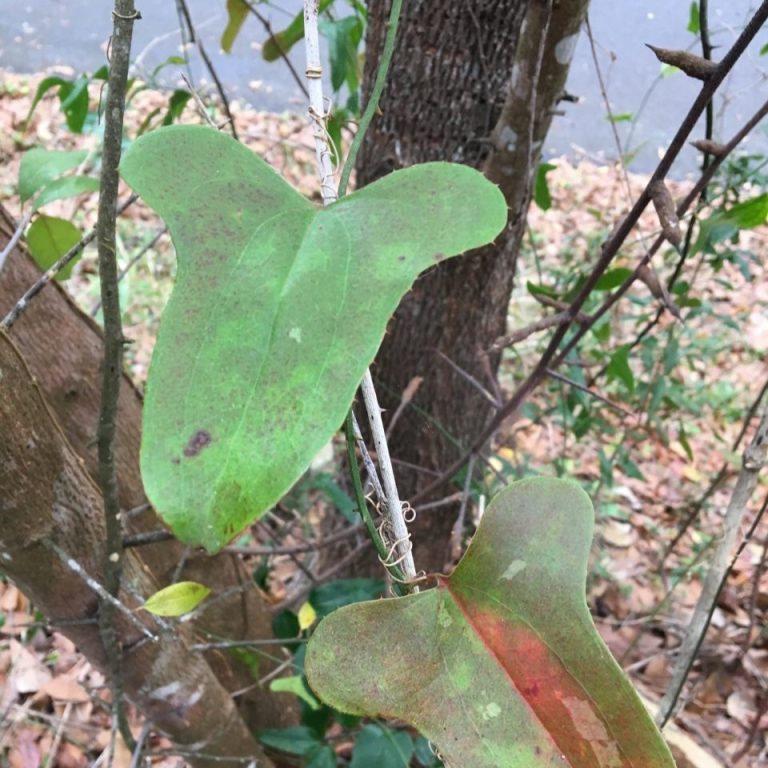
    For me, the most annoying of these vines is Catbrier, Smilax bona-nox, that has thorns and spines on every surface of the plant! This is the one that I am convinced has eyes, ears, or both – because whenever I walk where it lives, it waits for me to come close, at which point it wraps itself around my legs. As I have said, I have scars.

    But please give Greenbriers their due – they are mostly harmless, if you view them from afar.

    Hope to see you in our great outdoors!

    Title Slide – Eared-leaf Greenbrier (Smilax auriculata)

    catbrier greenbrier Smilax vines
    Previous ArticleMSU’s Famous Maroon Band Receives Highest National Collegiate Band Award
    Next Article A Potluck Favorite: Simple Jambalaya for Chilly Days
    Mark W. LaSalle, Ph.D.

    Mark is a naturalist and wetland ecologist, providing expertise on wetlands, water quality and environmental impacts of humans. He has also developed and conducted a number of environmental education programs and workshops for youth, teachers, realtors, and the general public on a variety of subjects including wetlands, natural history, and environmental landscaping. Mark is a graduate of the University of Southwestern Louisiana (B.S. and M.S. degrees) and Mississippi State University (Ph.D.). Mark is the recipient of the Chevron Conservation Award, the Mississippi Wildlife Federation Conservation Educator Award, the Gulf Guardian Award, and the Boy Scouts of America Silver Beaver Award.

    Related Posts

    Qu’est Que C’est

    Landscaping for Hummingbirds

    January 3, 2026
    Qu’est Que C’est

    A Season for Stewardship: Simple Winter Conservation Actions for Mississippi Families

    December 20, 2025
    Qu’est Que C’est

    Discovering Birds of Winter

    December 6, 2025
    Add A Comment
    Leave A Reply Cancel Reply

    You must be logged in to post a comment.

    Stay In Touch
    • Facebook
    • YouTube
    • TikTok
    • Twitter
    • Instagram

    Subscribe to Updates

    Get the latest good news happening in Mississippi!

    Most Popular

    The Old Farmer’s Almanac Has Spoken on Mississippi’s Fall Forecast

    July 25, 20258K Views

    Old Sayings Say It Best

    May 22, 20247K Views

    Actor Jeremy London Calls Mississippi Home

    August 1, 20247K Views
    Our Picks

    Find Your Next Library Event This January!

    January 3, 2026

    Landscaping for Hummingbirds

    January 3, 2026

    Why Lentil Vegetable Soup Is the Perfect Post-Holiday Reset

    January 2, 2026

    Subscribe to Updates

    Get the latest good news from Our Mississippi Home.

    Our Mississippi Home
    Facebook X (Twitter) Instagram YouTube TikTok RSS
    • About OurMSHome
    • Advertise
    • Community Partners
    • Privacy Policy
    • Guidelines
    • Terms
    © 2026 Our Mississippi Home. Designed by Know_Name.

    Type above and press Enter to search. Press Esc to cancel.

    Ad Blocker Enabled!
    Ad Blocker Enabled!
    Our website is made possible by displaying online advertisements to our visitors. Please support us by disabling your Ad Blocker.

    Sign In or Register

    Welcome Back!

    Login to your account below.

    Lost password?