



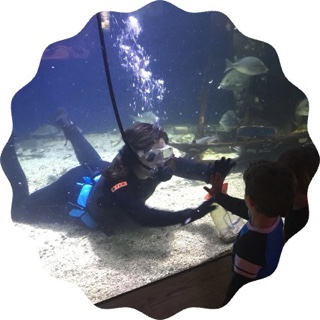
In a picture from her time as a volunteer education docent at the Mississippi Museum of Natural Science, Dr. Maria Wallace is in a dive suit, touching hands with little boys through aquarium glass as they gaze up in wonder. From glass-to-glass aquarium meetings to one-on-one discussions, her career centered on finding novel ways to spark interest in science.
Wallace, an associate professor in The University of Southern Mississippi’s Center for STEM Education (Center), dug into the potential of spaces outside of classrooms to educate learners of all ages. She researched the learning that happens at informal education sites like museums and zoos and instructed Southern Miss teachers-in-training using what she discovered. Her signature NExUS-MS project brought together Hattiesburg Zoo staff educators with aspiring and current K12 teachers and graduate students from diverse STEM fields to interact with the public, where USM interns and volunteers under her leadership reached over 15,000 zoogoers in one semester alone.
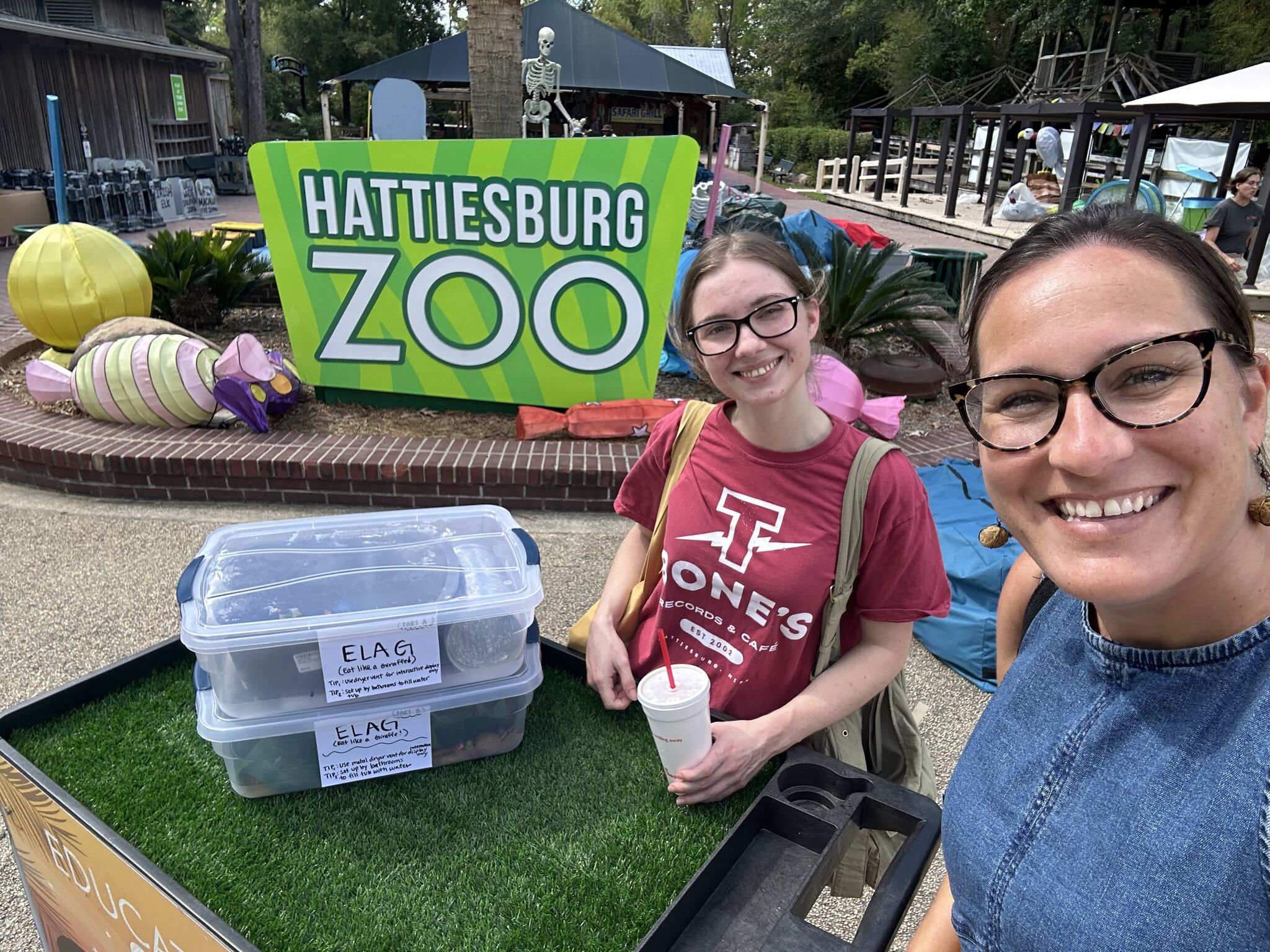
The 38-year-old passed away from Peripheral T Cell Lymphoma last month, leaving behind a husband and young daughter, as well as a host of colleagues and students feeling the loss. Testimonies to Wallace’s abilities as a teacher, researcher, mentor, and friend have surfaced across social media, with former students like Alexis Bosnake trying to put Wallace’s impact into words.
“She was far more than a professor; she was an advocate,” Bosnake said. “She always believed in education and how it can be reformed to achieve more meaningful instruction. Dr. Wallace made Southern Miss a better institution.”
As friends and family come to terms with her sudden passing, USM researchers Dr. Kristina Mojica and Rachel Lancaster have chosen to honor Wallace’s legacy by dedicating Toxic Beauty, a new exhibit conceived and developed by the pair at the Mississippi Aquarium in Gulfport, to her memory. The project, funded in part by the Center’s STEMonTheGO program, uses art created from beach-collected debris to highlight the ongoing problem of plastic pollution in our waterways. Mojica, a colleague of Wallace in USM’s School of Ocean Science and Engineering, and Lancaster, who earned a Center for STEM Education Certificate under her leadership, considered Wallace a mentor and a friend.
“Maria was a light and a force to be reckoned with. She shaped not only my professional path, but who I am personally, through her energy, her passion for STEM education, and her unwavering drive,” Dr. Mojica said. “She was a true mentor, equal parts sounding board, cheerleader, and steady support. Her legacy endures in the lives she touched, and this exhibit is a reflection of that lasting impact.”
Mojica, a biological oceanographer who researches micro- and nano-contaminants in the marine environment, is part of a global initiative to trace plastic pollution at that level, with PhD student Lancaster specifically focusing on detecting and counting nano-plastics in seawater. Together they have developed a novel technique to more rapidly and thoroughly get a picture of plastic contamination in a body of water down to the smallest amount.
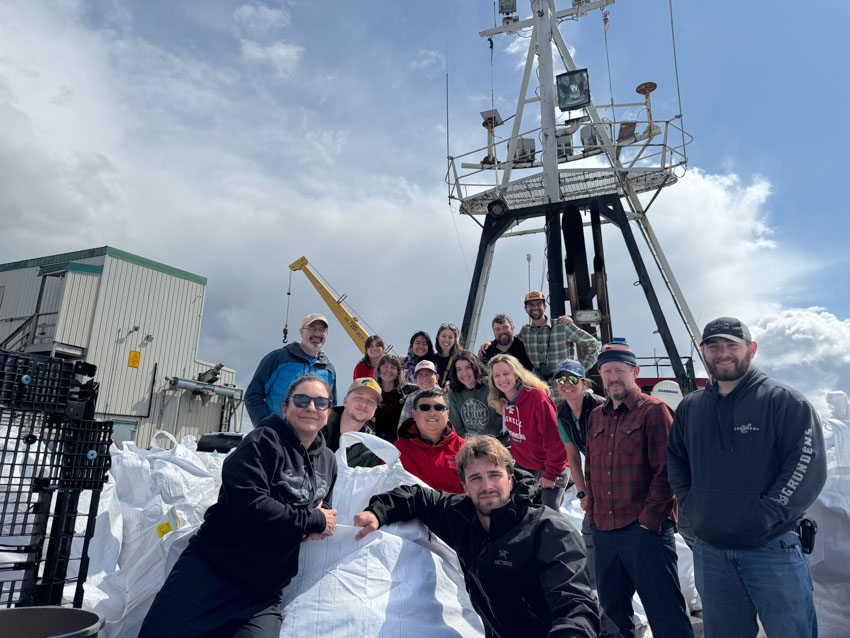
The two joined the Alaska Marine Debris Expedition as part of the NOAA-funded Ocean Plastics Recovery Project, joining a cruise in 2025 aboard the R/V Steadfast that removed from the water around 3,600 pounds of marine debris per day. As part of the expedition, they collected field samples to contribute to a global effort to better understand plastic’s impact on the world’s oceans.
The Toxic Beaty art exhibit, designed to call attention to those efforts, will run at Mississippi Aquarium from May 1 to September 5. As she reflected on how it felt to help launch such an ambitious project without a key mentor there to see it, Lancaster described how Wallace’s generosity as a teacher helped revive her own feelings about being an educator.
“Dr. Maria Wallace helped me rediscover the joys of formal and informal education. She really supported me at times when I struggled, and I can honestly say that she changed my perspective on life post-graduation, inspiring me to pursue opportunities in educational outreach,” said Lancaster. She added, “I pray for her family and loved ones, and hope they know how much she impacted not only my life, but also countless others for the better.”
*A special thank you to the USM Center for STEM Education for this beautiful tribute.
