



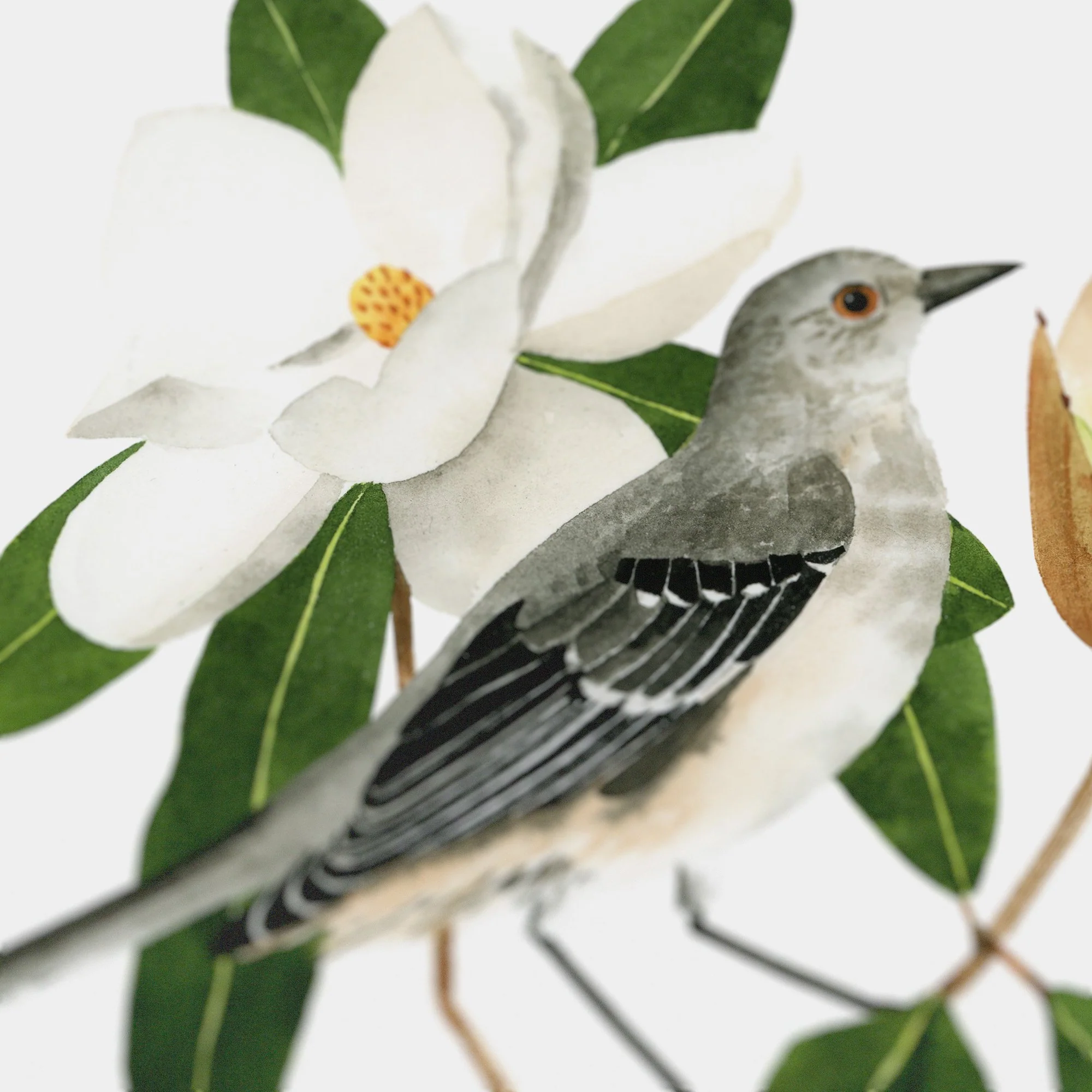
If you’ve ever lived in Mississippi, chances are you’ve heard one long before you’ve seen one.
Perched on a telephone wire, hidden in a crepe myrtle, or proudly standing atop a fence post, the Northern Mockingbird has a way of making itself known. With its gray feathers, white wing flashes, and seemingly endless repertoire of songs, it’s one of the most recognizable birds in the South—and it’s been Mississippi’s official state bird since 1944.
But what makes the mockingbird so special?
For starters, this talented little bird is an accomplished performer. While most birds sing only a handful of songs, a mockingbird can learn and mimic dozens—sometimes even hundreds—of different sounds throughout its lifetime. It can imitate other birds, frogs, insects, car alarms, barking dogs, and even the occasional squeaky gate. Male mockingbirds are especially known for stringing these sounds together into long, complex performances that can continue well into the night.
If you’ve ever wondered who was singing outside your window at 2 a.m., there’s a good chance a mockingbird was responsible.
The Northern Mockingbird is found throughout Mississippi and is remarkably adaptable. It thrives in small towns, bustling cities, rural farmland, and suburban neighborhoods alike. Unlike some wildlife that disappears as development expands, mockingbirds seem perfectly content living alongside people.
They’re also fiercely protective. During nesting season, these birds are known to defend their nests against much larger animals, including cats, dogs, hawks, and occasionally unsuspecting humans who wander a little too close. For a bird that weighs only a few ounces, it possesses an impressive amount of courage.
Perhaps that’s part of the reason Mississippians have embraced the mockingbird for generations. It’s resilient, resourceful, and not afraid to stand its ground.
The mockingbird has also earned a place in American literature and folklore. Its beautiful songs have inspired poets, writers, and musicians for centuries, and its ability to borrow and blend melodies from the world around it serves as a reminder that beauty often comes from paying attention.
The next time you hear a bird singing from a backyard tree or a power line above a quiet Mississippi road, take a moment to listen closely. You might hear a cardinal, a blue jay, a wren, and a few sounds you can’t quite identify—all coming from one remarkable bird.
That’s the magic of Mississippi’s state bird. The mockingbird doesn’t just sing its own song. Somehow, it sings a little bit of everyone else’s too.
