



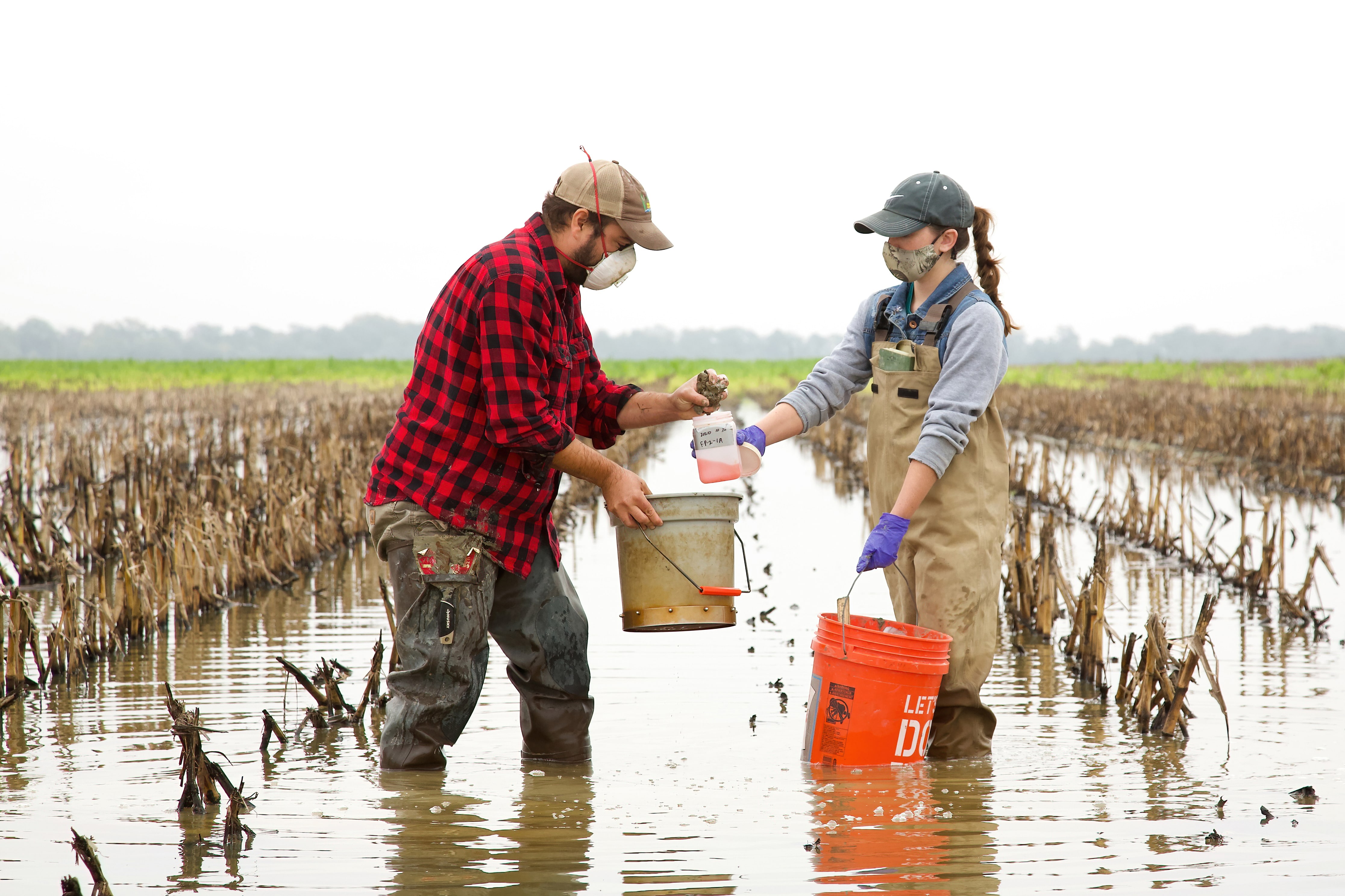
A University of Mississippi professor is using an Environmental Protection Agency grant to explore the potential benefits of holding runoff water on agricultural landscapes after crops are harvested.
The move could reduce the pollution of downstream waterways, improve soil health and crop yields, provide crucial food and habitat for migratory birds, reduce pumping of groundwater, and retain soil in agricultural fields, among other benefits.
The nearly $1 million grant from the EPA through its Farmer to Farmer grant funding program is based on four different farms in the Sunflower River watershed of the Mississippi Delta.
“Some of the key potential outcomes to this research project are to establish whether the benefits of temporary wetlands are consistent among farms and to reveal the mechanisms of how temporary wetlands influence the function of agricultural systems,” UM biology professor Jason Hoeksema said.
“Other potential outcomes are to promote more widespread adoption of these flooding practices in the region, if they prove to be consistently beneficial, and to improve the sustainability of agriculture in our region.”
Hoeksema, who joined the Ole Miss faculty in 2007, is principal investigator on the grant that includes a team of lead scientists and graduate students from the UM departments of Biology and Civil Engineering, Mississippi State University and the U.S. Department of Agriculture’s National Sedimentation Laboratory, which is in Oxford.
“We were thrilled that the EPA saw the potential value of our proposed research,” Hoeksema said. “We felt that our preliminary results were very compelling, so it was gratifying to receive the award. This project represents an exciting opportunity to benefit wildlife, our environment and the sustainability of agriculture.”
Running through the spring of 2024, the project will include three cycles of crops on the four farms.
“This EPA project is a wonderful example of community-engaged research at the University of Mississippi in which our researchers work with communities to design projects that lead to outcomes that can be readily implemented,” said Josh Gladden, UM vice chancellor for research and sponsored programs. “Agriculture is such a critical community, not only for our state but our nation.
“We are eager to see how the results of this work can benefit both our farmers and the ecosystems of our watersheds and the Gulf of Mexico.”
The researchers and farmers will set up five field treatment groups on each farm after crops are harvested each fall. The treatment groups will allow the researchers to experiment with a range of water conditions, from passive flood treatment, in which water control structures are used to stop rainfall runoff, to different seasonal flood treatments, in which surface water is added and held on fields.
“Different team members will sample various aspects of how the agricultural ecosystem responds to those treatments,” Hoeksema said.
The researchers will study the composition and diversity of birds, invertebrate animals and soil microbes; the health of the soil; nutrient cycling; sediment and chemicals in runoff water; and crop yield.
“Some sampling will take place every week or two, some after rainfall events and some only once or twice per year,” Hoeksema said. “Data will be analyzed to compare those system responses among the five treatments.”
Impact on the World
The Mississippi Delta is part of the Gulf of Mexico watershed, a region where farmers provide food and fuel for the world.
A challenge facing this landscape is minimizing pollution, specifically the excess nitrogen and phosphorous that can enter water bodies through runoff or soil erosion. These excess nutrients enter the Gulf of Mexico, harming the productive body of water that has great ecological, economic and social value.
The farmers who work the land have developed skills and innovative practices to reduce this pollution, and they share their knowledge with other stakeholders, including state governments, farm organizations, conservation groups, educational institutions, nonprofit organizations and community groups.
The Farmer to Farmer grants support the leadership of farmers in improving water quality, habitat, resilience and peer-to-peer information exchange to benefit communities and ecosystems in the Gulf of Mexico watershed, according to the EPA.
“EPA is proud to support the leadership of farmers and their innovative approaches to improve water quality while working to fuel and feed the world,” EPA Administrator Michael S. Regan said. “EPA is committed to meaningful partnerships with farmers to advance sustainable agriculture practices while creating healthy, clean and safe environments for all.”
Titled “Restoring Temporary Wetland Function to Agricultural Watersheds with Innovative Farmer-Driven Offseason Water Management Practices,” UM’s $999,957 grant is one of 12 projects selected by the EPA in 2021 for its Farmer to Farmer program.
The project is a partnership between university and government researchers and farmers, with the goal, if the project is successful, of replicating it elsewhere.
“Ultimately, if flooding agricultural fields to create temporary wetlands during fallow seasons is proven beneficial, it will only result in consequential impacts if this practice is widely adopted by farmers,” Hoeksema said.
“Moreover, only farmers can ensure that these practices are implemented in ways that make sense in the context of a working farm. As such, it is essential to involve farmers from the very beginning, and to facilitate conversations among them to promote exchanges of ideas, opinions and experience.”
Hoeksema’s original goal of the project was to work with farmers to sustainably create habitat for migratory shorebirds on working farmlands in the Mississippi Delta. These birds come through the region in large numbers in spring and fall, and they need high-quality mudflats and shallow water habitat for stopover and feeding during their arduous journeys.
Exciting and Satisfying Work
“Working agricultural landscapes present a great opportunity for creating this habitat, and we were exploring how to do this without pumping groundwater by partnering with farmers who were recycling and saving the runoff water from their crop fields, pumping it back onto the fields after crop harvest,” Hoeksema said.
Jason Taylor, a research ecologist with the National Sedimentation Laboratory and Hoeksema’s collaborator, had the idea to measure numerous other potential ecosystem benefits, including soil sediment retention and reduction of downstream nutrient pollution by microbial activity.
Taylor’s preliminary data on those additional benefits were compelling and provided the impetus for the proposal to the EPA, with the project potentially offering several beneficial outcomes.
The research continues Hoeksema’s interest in how species, including soil microbes, can influence ecosystem processes. He also explores the ecological and evolutionary consequences of species interactions and co-invasions, with a focus on interactions between plants and fungi.
“My original interest in biology, when I was a young student, was in bird biology and conservation,” Hoeksema said. “Since then, although my university research program has not involved birds or agricultural systems, I’ve been involved in bird conservation projects on working lands through my outreach activities and the nonprofit that I co-founded in 2013, Delta Wind Birds.
“This EPA-funded project brings all of those interests and activities together into my university research program for the first time, which is very exciting and satisfying for me.”
