




Bryce Ramsey learned the importance of listening to her body and encouraged others to do the same. Even though she was a nurse with 16 years of experience, she overlooked subtle signs, as so many do, when they first appeared in her own life. Luckily, her instincts kicked in, and she got the care she needed.
“At first, I just brushed off my symptoms, because they were so minuscule, and I was only 33 years old,” explained Ramsey. “I had fatigue, and did start noticing a little bit of blood in my stool, but I chalked it up to the fact that I had just had a 10 and a half pound baby, I’m a nurse, and on my feet all the time working 12-hour shifts. I assumed it’s probably just hemorrhoids.”
Ramsey’s nurse’s instinct was alert enough to make her take notice if the symptoms progressed.
“I made a deal with myself,” Bryce recalls. “If this happens again, I’m calling for an appointment.”
As symptoms lingered, Ramsey called GI Associates, where Cindy Haden Wright, MD, didn’t write off her concerns. Dr. Wright explained that normally she wouldn’t scope someone at such a young age, but because a family history of colon cancer had just come to light, she moved forward with a colonoscopy.
The results were life-changing: a 5 cm polyp in her sigmoid colon. It was too large to remove via standard procedures, but she had it biopsied, and a referral to a surgeon was made.
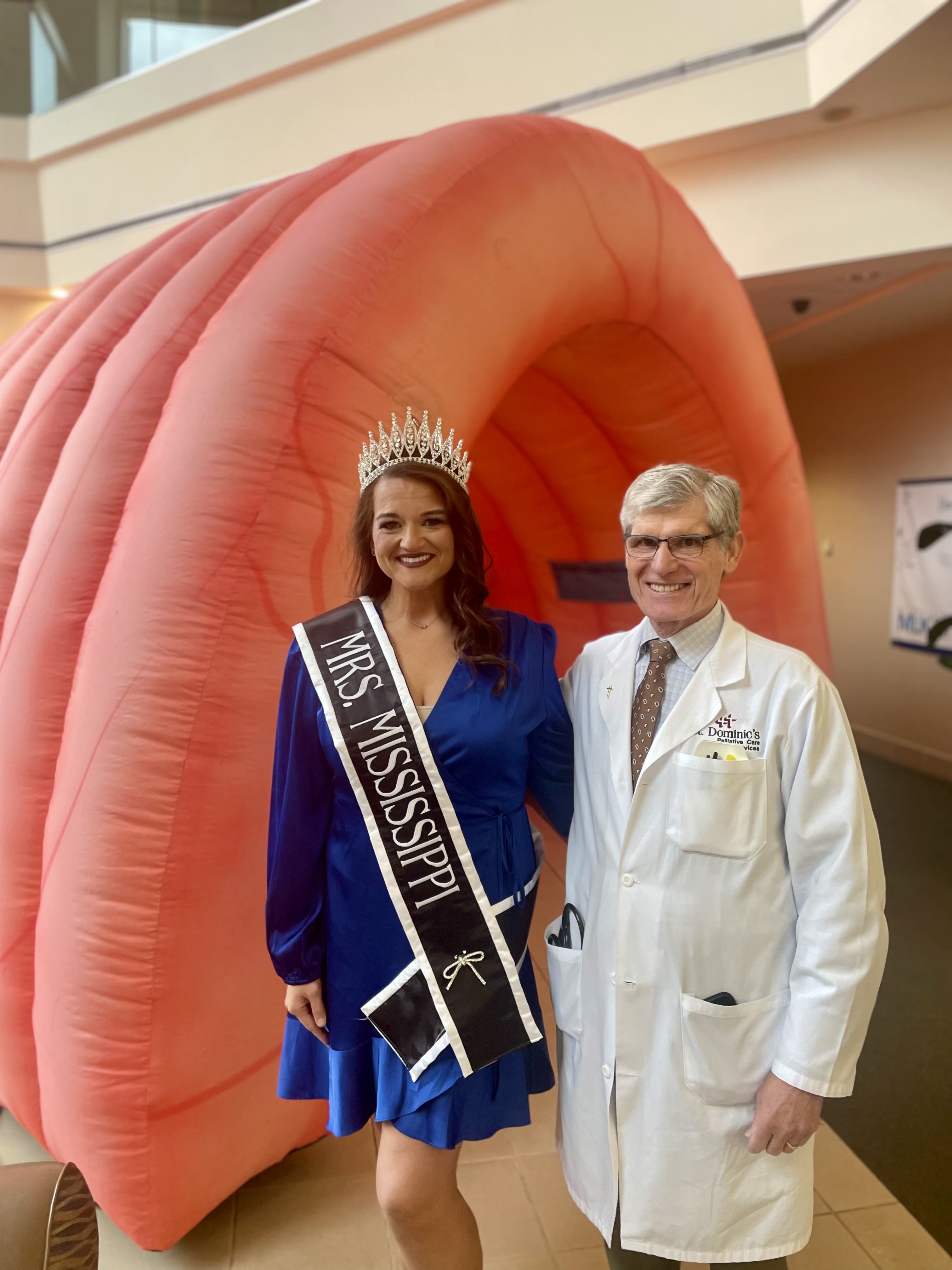
“I was headed to meet with the general surgeon when my phone rang,” shared Ramsey. “As a nurse, I know if the doctor calls you, it’s not a good thing. And she said, “Bryce, are you sitting down?”
Ramesey learned that she had adenocarcinoma of the sigmoid.
“I kept my appointment with the surgeon and scheduled my surgery,” shared Ramsey. “We removed three feet of my colon and 13 lymph nodes. Three of the 13 removed were positive, which made it stage three. Being diagnosed at 33 is still classified as a young adult.”
Now a six-year colon cancer survivor, Ramsey uses her story to educate and advocate for others. Crowned Mrs. Mississippi Plus America in 2024, she has made colon cancer awareness her platform, urging people to listen to their bodies.
“Bleeding from your behind is not normal,” Ramsey emphasizes. “People are embarrassed to talk about it, but I try to make them comfortable. I’d rather it be a false alarm than a missed diagnosis.”
Her advocacy has motivated her own friends and family to take action.
“Once I found out about my diagnosis, I begged my dad, my brother, and my aunt to all get screened,” shared Ramsey. “We found out that all three had cancer!”
Due to the high volume of cancer diagnoses, Ramsey advocated for her family to get genetic testing for Lynch’s syndrome. IT makes you more susceptible to genetic mutations and abdominal cancers.
“In the last six months, I’ve had four very dear friends, two stage four and two stage three diagnoses. And they are actually a year or two younger than I am,” shared Ramsey.
As of recently, colon cancer has surpassed breast cancer as the leading cause of death in cancer patients younger than 50 years old. Doctors now recommend that adults at average risk for colorectal cancer start regular screening at age 45, instead of 50. People with a family history of colorectal cancer, genetic syndromes (like Lynch syndrome), or inflammatory bowel disease (IBD) should speak with their doctor about starting screenings earlier than 45.
If you experience red flags like rectal bleeding, changes in bowel habits, or unexplained weight loss, talk to a doctor immediately, regardless of your age.
*All photos provided by Bryce Ramsey
