


Skip to content
Close Menu

    Subscribe to Updates

    Get the latest creative news from FooBar about art, design and business.

    Most Viewed

    The Old Farmer’s Almanac Has Spoken on Mississippi’s Fall Forecast

    July 25, 2025

    Old Sayings Say It Best

    May 22, 2024

    Actor Jeremy London Calls Mississippi Home

    August 1, 2024

    The Julep Room: A Hole in the Wall with History

    January 8, 2024
    Facebook X (Twitter) Instagram
    Sunday, February 8, 2026
    Trending
    • Great Horned Owls – So Many Cool Facts
    • Krewe of Gilles Crowns Royalty in Endless Summer Ball
    • A Place to Splash, Learn, and Belong: A Community Vision Taking Shape in Tylertown
    • Theatre MSU Brings the Heat, Razor-Sharp Wit to 2026 Season
    • A Forecast of Baseball
    Facebook X (Twitter) Instagram YouTube TikTok
    Login
    Our Mississippi HomeOur Mississippi Home
    • Living

      Krewe of Gilles Crowns Royalty in Endless Summer Ball

      February 6, 2026

      A Place to Splash, Learn, and Belong: A Community Vision Taking Shape in Tylertown

      February 6, 2026

      A Forecast of Baseball

      February 5, 2026

      Mississippi Main Street Association Awards Community Development Grants 2025-2026

      February 4, 2026

      Climbing Toward the Light: The Legacy of Mississippi’s Lineworkers

      February 4, 2026
    • Arts / Culture

      Theatre MSU Brings the Heat, Razor-Sharp Wit to 2026 Season

      February 5, 2026

      Southern Miss Connoisseurs Series Features World-Class Artists in Free Concerts

      January 28, 2026

      MSU Riley Center Unveils 2026 Spring/Summer Performing Arts Series

      January 23, 2026

      Southern Miss School of Music Welcomes Community to Two Free Concert Showcases in February

      January 22, 2026

      “The Ball” Continues to Stand Alone Among Carnival Events

      January 22, 2026
    • Entertainment

      WMSV The Junction Listeners ‘Rise and Ring’ With On-Air Bulldog Talent

      January 29, 2026

      Where Faith, Family, and Music Meet: Shay and Michi Guess of Mantachie

      January 14, 2026

      From Hawkins to the Coast: Stranger Things Finale Comes to Mississippi

      December 16, 2025

      Love in the Layover: A Holiday Story Rooted in Connection

      December 1, 2025

      Pascagoula Celebrates Alien Abduction Legend

      October 7, 2025
    • Food & Dining

      Exploring the Coast, One Bite at a Time

      February 2, 2026

      A Coastal Favorite for Coffee, Conversation, and Comfort Food

      January 25, 2026

      Ole Miss Football Victory Tastes Like Chicken

      December 29, 2025

      Leftovers With Style: Turning Holiday Extras Into Inspired Meals

      December 28, 2025

      A Potluck Favorite: Simple Jambalaya for Chilly Days

      December 14, 2025
    • Environment

      Great Horned Owls – So Many Cool Facts

      February 7, 2026

      Watching Birds That Flock Together in Winter

      January 31, 2026

      The Gift of Wetlands – Tidal Marshes

      January 24, 2026

      We’ve Been Here Before: Remembering Mississippi’s Ice Storm of 1994 as Winter Weather Returns

      January 22, 2026

      Winter Tides

      January 17, 2026
    • Lagniappe
      • Business
      • Sports
      • Education
      • Health & Wellness
      • OurMSVoices
      • People
    Subscribe
    Our Mississippi HomeOur Mississippi Home
    Home»Just for Fun»Record Broken: Hubble Spots Farthest Star Ever Seen
    Just for Fun

    Record Broken: Hubble Spots Farthest Star Ever Seen

    NASABy NASAMarch 31, 20225 Mins Read3 Views
    Share Facebook Twitter Pinterest LinkedIn Tumblr Reddit Telegram Email
    Share
    Facebook Twitter LinkedIn Pinterest Email Copy Link

    NASA’s Hubble Space Telescope has established an extraordinary new benchmark: detecting the light of a star that existed within the first billion years after the universe’s birth in the big bang – the farthest individual star ever seen to date.

    The find is a huge leap further back in time from the previous single-star record holder; detected by Hubble in 2018. That star existed when the universe was about 4 billion years old, or 30 percent of its current age, at a time that astronomers refer to as “redshift 1.5.” Scientists use the word “redshift” because as the universe expands, light from distant objects is stretched or “shifted” to longer, redder wavelengths as it travels toward us.

    The newly detected star is so far away that its light has taken 12.9 billion years to reach Earth, appearing to us as it did when the universe was only 7 percent of its current age, at redshift 6.2. The smallest objects previously seen at such a great distance are clusters of stars, embedded inside early galaxies.

    “We almost didn’t believe it at first, it was so much farther than the previous most-distant, highest redshift star,” said astronomer Brian Welch of the Johns Hopkins University in Baltimore, lead author of the paper describing the discovery, which is published in the March 30 journal Nature. The discovery was made from data collected during Hubble’s RELICS (Reionization Lensing Cluster Survey) program, led by co-author Dan Coe at the Space Telescope Science Institute (STScI), also in Baltimore.

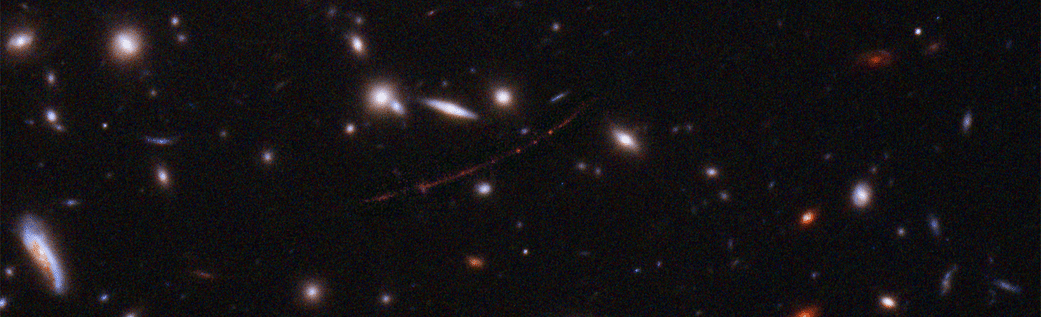
    “Normally at these distances, entire galaxies look like small smudges, with the light from millions of stars blending together,” said Welch. “The galaxy hosting this star has been magnified and distorted by gravitational lensing into a long crescent that we named the Sunrise Arc.”

    After studying the galaxy in detail, Welch determined that one feature is an extremely magnified star that he called Earendel, which means “morning star” in Old English. The discovery holds promise for opening up an uncharted era of very early star formation.

    “Earendel existed so long ago that it may not have had all the same raw materials as the stars around us today,” Welch explained. “Studying Earendel will be a window into an era of the universe that we are unfamiliar with, but that led to everything we do know. It’s like we’ve been reading a really interesting book, but we started with the second chapter, and now we will have a chance to see how it all got started,” Welch said.

    When Stars Align

    The research team estimates that Earendel is at least 50 times the mass of our Sun and millions of times as bright, rivaling the most massive stars known. But even such a brilliant, very high-mass star would be impossible to see at such a great distance without the aid of natural magnification by a huge galaxy cluster, WHL0137-08, sitting between us and Earendel. The mass of the galaxy cluster warps the fabric of space, creating a powerful natural magnifying glass that distorts and greatly amplifies the light from distant objects behind it.

    Thanks to the rare alignment with the magnifying galaxy cluster, the star Earendel appears directly on, or extremely close to, a ripple in the fabric of space. This ripple, which is defined in optics as a “caustic,” provides maximum magnification and brightening. The effect is analogous to the rippled surface of a swimming pool creating patterns of bright light on the bottom of the pool on a sunny day. The ripples on the surface act as lenses and focus sunlight to maximum brightness on the pool floor.

    This caustic causes the star Earendel to pop out from the general glow of its home galaxy. Its brightness is magnified a thousandfold or more. At this point, astronomers are not able to determine if Earendel is a binary star, though most massive stars have at least one smaller companion star.

    Confirmation with Webb

    Astronomers expect that Earendel will remain highly magnified for years to come. It will be observed by NASA’s James Webb Space Telescope. Webb’s high sensitivity to infrared light is needed to learn more about Earendel, because its light is stretched (redshifted) to longer infrared wavelengths due to the universe’s expansion.

    “With Webb we expect to confirm Earendel is indeed a star, as well as measure its brightness and temperature,” Coe said. These details will narrow down its type and stage in the stellar lifecycle. “We also expect to find the Sunrise Arc galaxy is lacking in heavy elements that form in subsequent generations of stars. This would suggest Earendel is a rare, massive metal-poor star,” Coe said.

    Earendel’s composition will be of great interest for astronomers, because it formed before the universe was filled with the heavy elements produced by successive generations of massive stars. If follow-up studies find that Earendel is only made up of primordial hydrogen and helium, it would be the first evidence for the legendary Population III stars, which are hypothesized to be the very first stars born after the big bang. While the probability is small, Welch admits it is enticing all the same.

    “With Webb, we may see stars even farther than Earendel, which would be incredibly exciting,” Welch said. “We’ll go as far back as we can. I would love to see Webb break Earendel’s distance record.”

    Previous ArticleBanana Pudding and Pecan Pie Recipes From Mom
    Next Article Put Potatoes Back on Your Plate!
    NASA
    • Website

    Related Posts

    Featured

    Catfish, Crappie & a Countdown: How Mississippi Rings in the New Year

    December 29, 2025
    Entertainment

    From Hawkins to the Coast: Stranger Things Finale Comes to Mississippi

    December 16, 2025
    Community Picks

    Pascagoula Celebrates Alien Abduction Legend

    October 7, 2025
    Add A Comment

    Comments are closed.

    Stay In Touch
    • Facebook
    • YouTube
    • TikTok
    • Twitter
    • Instagram

    Subscribe to Updates

    Get the latest good news happening in Mississippi!

    Most Popular

    The Old Farmer’s Almanac Has Spoken on Mississippi’s Fall Forecast

    July 25, 20258K Views

    Old Sayings Say It Best

    May 22, 20247K Views

    Actor Jeremy London Calls Mississippi Home

    August 1, 20247K Views
    Our Picks

    Great Horned Owls – So Many Cool Facts

    February 7, 2026

    Krewe of Gilles Crowns Royalty in Endless Summer Ball

    February 6, 2026

    A Place to Splash, Learn, and Belong: A Community Vision Taking Shape in Tylertown

    February 6, 2026

    Subscribe to Updates

    Get the latest good news from Our Mississippi Home.

    Our Mississippi Home
    Facebook X (Twitter) Instagram YouTube TikTok RSS
    • About OurMSHome
    • Advertise
    • Community Partners
    • Privacy Policy
    • Guidelines
    • Terms
    © 2026 Our Mississippi Home. Designed by Know_Name.

    Type above and press Enter to search. Press Esc to cancel.

    Ad Blocker Enabled!
    Ad Blocker Enabled!
    Our website is made possible by displaying online advertisements to our visitors. Please support us by disabling your Ad Blocker.

    Sign In or Register

    Welcome Back!

    Login to your account below.

    Lost password?