



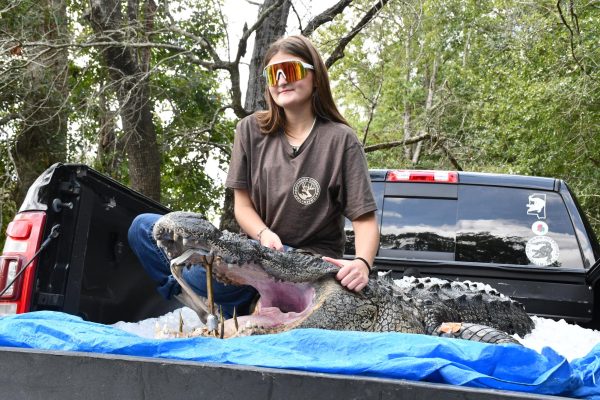
GAUTIER-When a 12-foot, 4-inch alligator jumped out of the water, Zoe Pell realized the hunt this year would be much different from the year before.
“As soon as he drove up out of the water, he jumped and we realized that this wasn’t a little like we thought,” Zoe said. “We realized that it was a lot bigger than what we imagined.”
The 15-year-old from Utica, Miss., had caught a 6-foot, 7-inch alligator during her first hunt with Southern Outdoors Unlimited, a nonprofit that connects disabled youth with guided hunting opportunities through volunteer hunters, in 2025. In 2026, she brought in an alligator nearly twice that size.
“It was a really big fight,” Zoe said. “He, he kept going to the bottom and staying at the bottom. He was not coming up at all.”
For Zoe and her mother, Ashley Pell, the hunt represented more than the size of the alligator. It was another sign of how far Zoe has come since an illness changed her life.
Only hunting remained
When Zoe was 3 years old, she was diagnosed with Behcet’s disease, a rare inflammatory disorderthat can affect blood vessels throughout the body.
“It’s a painful disorder,” Ashley explained. “It kind of has the same symptoms of arthritis, so you have the inflammation and the blood pain of an arthritic in the joints.”
Even though Zoe was diagnosed with Behcet’s, she was still able to go to school, play softball and basketball and ride horses. But three years ago, Zoe woke up one morning and was partially paralyzed on her right side.

After she was rushed to the doctor, medical staff determined Zoe also had ANCA-associated vasculitis, a group of rare autoimmune disorders that cause inflammation in small and medium blood vessels.
“I was diagnosed like three years ago with a rare disorder that partially paralyzed me on my right side,” Zoe said. “(The doctor) told me that what I have is rare, and that it would put me in, probably a wheelchair one day.”
Behcet’s disease has no cure, although treatment can help control symptoms. ANCA-associated vasculitis can be treated into remission but may relapse. As part of her treatment, Zoe had to start a regimen of chemotherapy, steroids and IVs and stop doing activities that caused stress on her body.
“My doctor basically told me that I had to give up everything, that hunting and stuff was probably about the only thing I could do,” she said. “I gave up school, softball, basketball. I gave up all my sports. Almost gave up horse riding with it.”
Since her diagnosis three years ago, Zoe has recovered enough to go hunting. Through Southern Outdoors Unlimited and G6:2 Outdoors Ministry, another nonprofit that provides hunting opportunities for children with disabilities, hunting has kept her active.
“That’s the one thing that she’s not had to give up, is her hunting,” Ashley said. “And that’s why I’ve been very grateful for (Southern Outdoors Unlimited), because even though she’s been battling chemo and she’s been battling this disorder, she’s still able to go hunt and do the things that she loves to do.”
Finding a place to hunt
Zoe has since hunted alligators, deer, hogs, squirrels and rabbits through Southern Outdoors Unlimited.

“I was invited to start doing it by deer hunting, and then they told us that they had the gator hunt, and I was like, you know what? I want to try that one,” Zoe said.
Ashley said hunting gives her daughter a chance to get outside despite her health challenges.
“So you just enjoy the outdoors and being able to hunt, because that’s the one sport that she’s able to do, even though she has the disabilities that she has,” Ashley said.
Zoe also tries to help other young hunters. Ashley said Zoe harvested two deer during a hunt last year and gave one to a participant who didn’t get one.
Returning to the field
Three years after stepping away from sports, Zoe recently began playing softball and basketball again.
“When I put everything down, I put it down and didn’t expect to pick it up,” Zoe said. “I’m very, very rusty on it, but I’ve done pretty good.”
Zoe’s ability to return to sports followed 11 rounds of chemotherapy, steroids and persistence.
Ashley described her daughter as someone who continues pushing even on difficult days.
“She’s strong. She’s a strong girl. She’s a fighter,” Ashley said. “Even on her worst days, she is still up trying to push through it.”
Her persistence was tested again as Zoe worked to bring the alligator to the surface. She credited Mike Macko, the organization’s alligator coordinator, and others on the hunt with helping place a second hook into the animal.
Zoe said she was proud of the result.
“When I put my mind to it, I don’t give up and I’m going to succeed,” Zoe said.
For Ashley, the 12-foot, 4-inch alligator was further proof of the strength she has seen throughout her daughter’s life.
“When she was born, she came into this world as a fighter,” Ashley said. “Everything she does, she gives it all. And she fights with every minute she has in her.”
Contributors: and
