



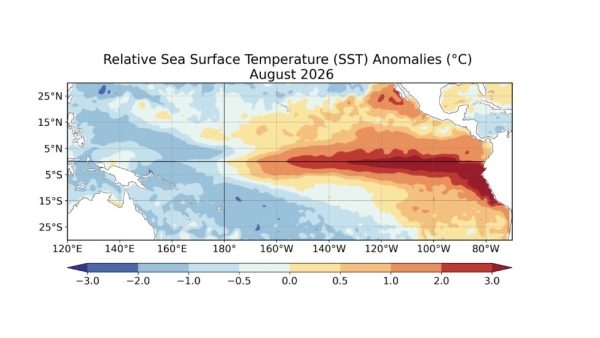
The El Niño-Southern Oscillation, or ENSO, is an atmospheric teleconnection— in which weather at one location relates to weather at another, sometimes thousands of miles away — that involves the direction and strength of the trade winds.
In a typical year, trade winds over the Pacific Ocean push warm surface water westward toward Australia and Indonesia.
However, when an El Niño occurs, the trade winds weaken or can reverse direction. As a result, warm surface water spreads eastward across the equatorial Pacific toward the western coasts of North and South America. This pattern typically lasts nine to 12 months and often peaks around December.
Teleconnections work through cycles that are constantly monitored by the National Oceanic and Atmospheric Administration. NOAA’s Climate Prediction Center measures variables such as temperature and sea-level pressure to determine current teleconnection patterns.
Why are people calling this year a “Super El Niño”?
The American Meteorological Society’s peer-reviewed glossary includes an abundance of meteorological terms using “super.” However, “Super El Niño” is not one of them.
Meteorologists forecast an El Niño by predicted strength. The current El Niño forecast reflects a 90% chance of the pattern becoming extremely strong. This means Pacific sea-surface temperatures are much warmer than normal because of changes in the trade winds.
While not an official term, “Super El Niño” likely refers to the predicted strength of the weather pattern itself. However, news consumers should watch for sensationalized headlines that use the term without context or make unsupported claims.
What can South Mississippi expect during the 2026-27 El Niño season?
Past observations allow the National Weather Service to make predictions about Mississippi weather trends.
During an El Niño, expect a below-average hurricane season because of increased wind shear. From November to March, South Mississippi and other areas along the Gulf Coast may experience increased rainfall and severe weather associated with cold fronts.
“Super El Niño” may be a sensationalized headline for clicks, but the wise words of James Spann may come in handy this winter — respect the polygon.
Contributors: and
