



My series of short stories about the creepy crawly and green pieces and parts of our natural world is based on my lifelong curiosity about nature, regardless of if I knew what they were. I grew up in the 60s in south Louisiana, before air conditioning was a thing. I do not recall being hot but outdoors was where I spent most of my time, looking for stuff! That was the origin of my Qu’est Que C’est journey.
Those adventures led to my search for ways to put names to those living things, which sent me to the library and Golden Guides that my parents acquired for me, some of which I still have. So, yes, the phrase “what is that” (Qu’est Que C’est) was mumbled under my breath and out loud, early on, and often.
So, I thought I would share a story about where this drive for knowing what it was grew during my journey to becoming a biologist. It is a story of a challenge of finding out what a dark blob of disfigured tissue had been in life. With the help of my office mate in graduate school, we solved one of the most challenging cases of Qu’est Que C’est.
Augustus Mamaril (Tus) and I shared an office/lab and a love of invertebrates. Tus is Filipina and became a dear friend. I was knee deep in spiders and he in zooplankton, but we both had a solid base of knowledge about the range of invertebrate organisms that live among us. So it was that our major professor showed up one day with a vial that held that dark blob that had been found in the bottom of a soda bottle. An attorney showed up at the biology department to get an identification, after his client discovered said blob in that bottle.
In those days, soda was sold in reusable glass bottles that could be returned to local stores. Bottling companies would clean and sterilize them for refilling. I was one of the kids in those days that collected bottles from ditches and roadsides, getting up to a dime for each bottle. Given where bottles were found, I was not surprised that a critter might find its way in and become trapped.
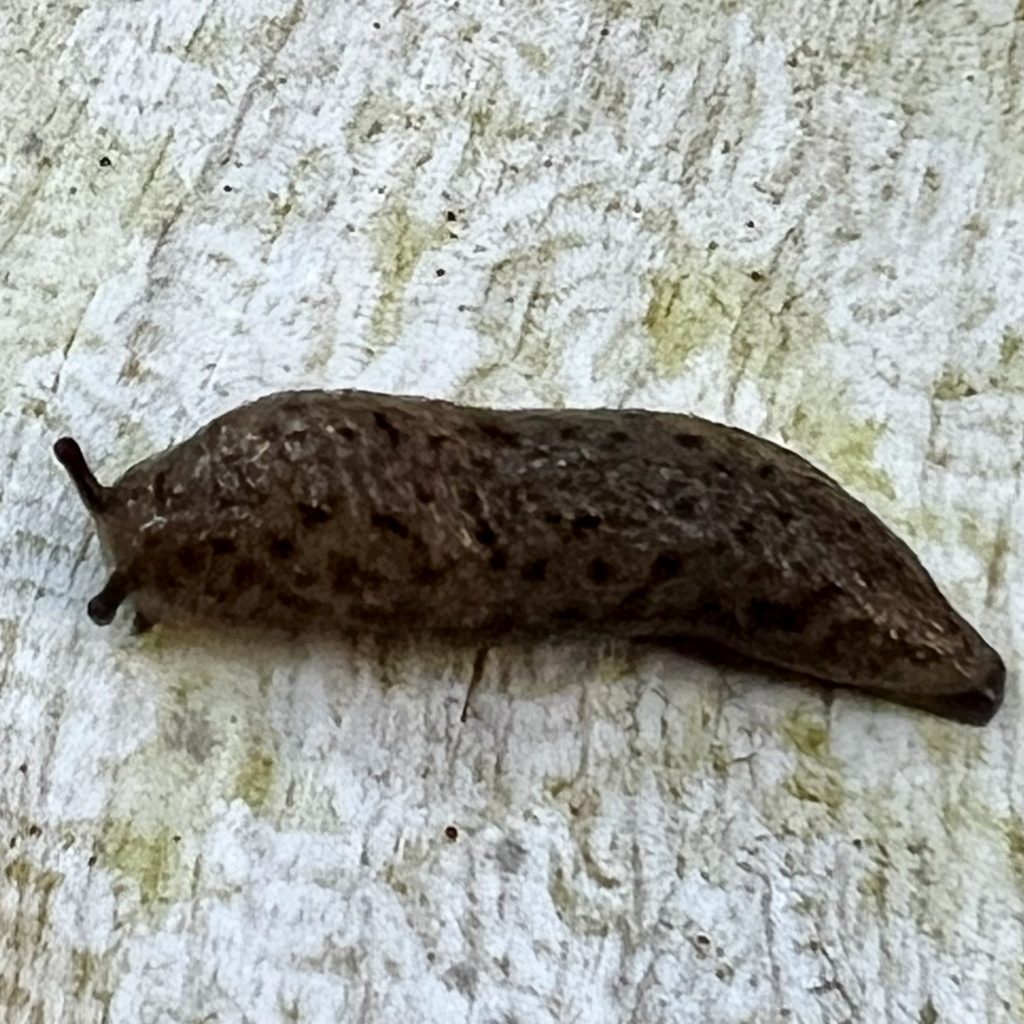
The blob we examined was elongate, about an inch and a half long, a half inch in diameter, and kinda, sorta tapered on both ends. Its surface had clearly been affected by the soda since being trapped in the bottle. It felt like and responded like a piece of rubber, easily bent, yet springing back to its original form. There was no apparent front, back, up, down, mouth or other openings to the blob, so we took our time to scratch our heads and drink more coffee.
Now most animals have a front, back and up and down, so we decided that we needed to see inside the blob to get better clues. A quick slice with a scalpel and it came to us almost immediately. “It’s a SLUG!” We had both studied the basic anatomy of many groups of invertebrates to spot what clearly was the “foot” of what we knew as slugs and snails. The tough foot that we sliced through showed us the bottom. The external clues of a slug had been disfigured by the soda. Case solved.
I often wonder what became of the case of “the blob in my soda”, but we celebrated our combined success in unmasking the beast. Not sure how much our major professor thought of our skills, but he seemed pleased, and likely took much of the credit.
The moral of this story is that curiosity is a good thing. It can push us to look a little deeper, ask better questions, and keep going until we find the answer. So, now you know the story behind Qu’est Que C’est.
Hope to see you in our great outdoors!
