



Spiders are all around us: in our landscapes, our homes, and even our vehicles. My grandchildren are always excited to report a web or small spider lurking in my vehicle. They all know not to kill them and that Paw Paw will show them the door, or not. Of course these are the spiders in plain view, but many others reside out of sight, like Trapdoor Spiders. Of the spiders that live underground, these critters take concealment to the max.
Finding the home of a Trapdoor Spider is just plain luck. I once spotted a circular outline in a small embankment along a pathway that turned out to be the hinged door of such a spider. Luck, yes, but with a better chance than most, since I tend to look for odd shapes in our world that turn out to be critters of some sort. I was unable to coax the owner to come out to play, like I have been able to do with Turret Spiders, another of our burrowing spiders. But that was 40 years ago.
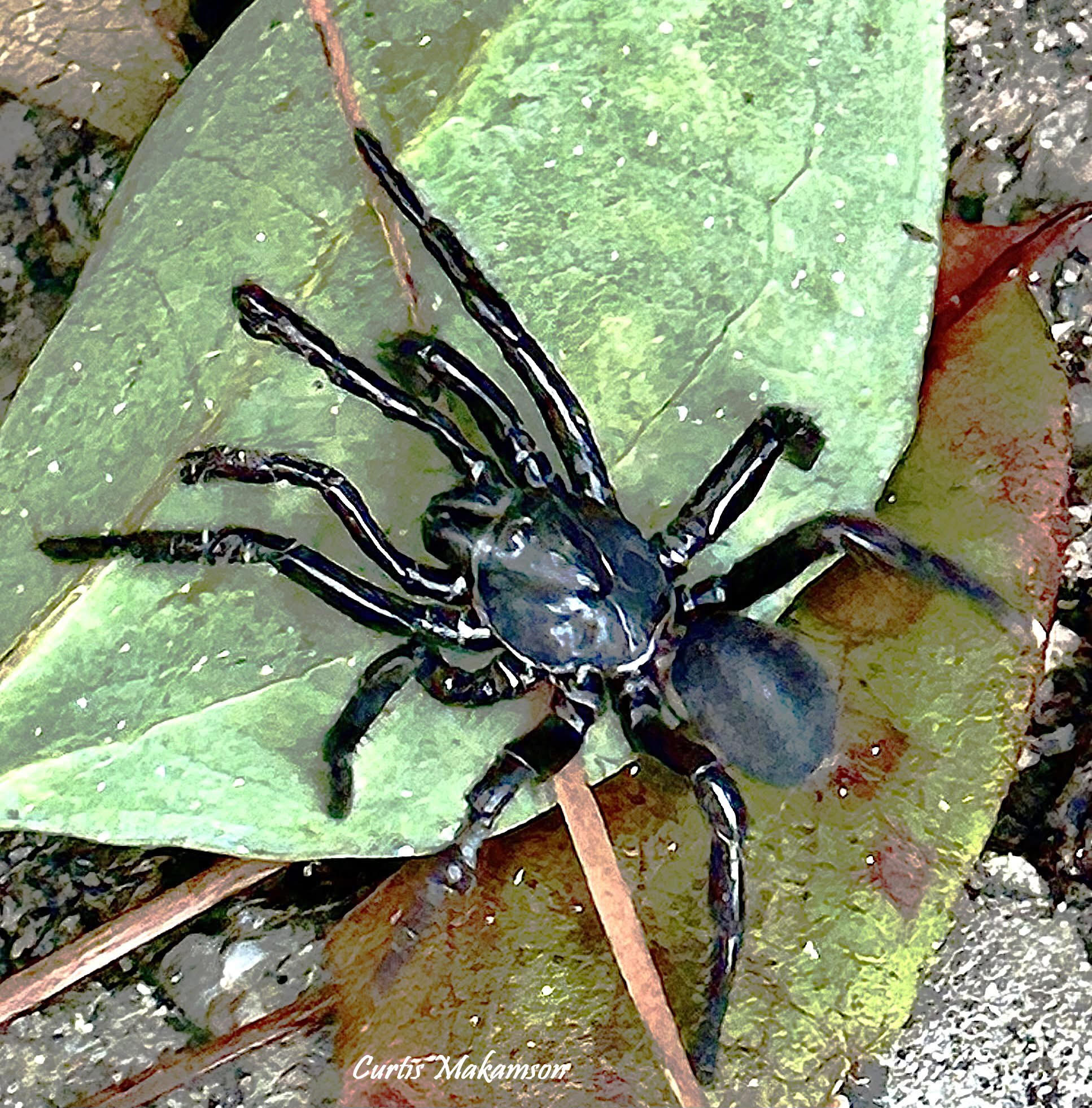
Most observations of these large spiders have been in summer, when males venture from their lairs to seek out females, that do not leave their homes. This was just such a chance encounter with the subject of this story for my friend Curtis Makamson in July of this year.
Other than been out in the open, males have longer legs than females, with long pedipalps that resemble legs, located on either side of the fangs. Pedipalps are leg-like structures used to help manage prey, but in males, they are also used to transfer sperm during mating.
Unlike females that spend their entire lives in their burrows, and may live for upwards of 20 years, males live for only a few years. Being in the open exposes spiders to predators, like spider wasps that specialize in hunting spiders to stock their nest for their larvae. Yet even female Trapdoor Spiders can fall victim to spider wasps that simply sting their prey and stuff the spider and a single egg back into the spider’s burrow.
Outside of the mating season when males move about (summer), Trapdoor spiders are nocturnal, making finding a closed lair hard to spot during the day. The burrow is silk-lined and a few inches deep, depending on the age of its owner. The door is circular and hinged on the top side, fitting tightly when closed, looking just like the surrounding soil.
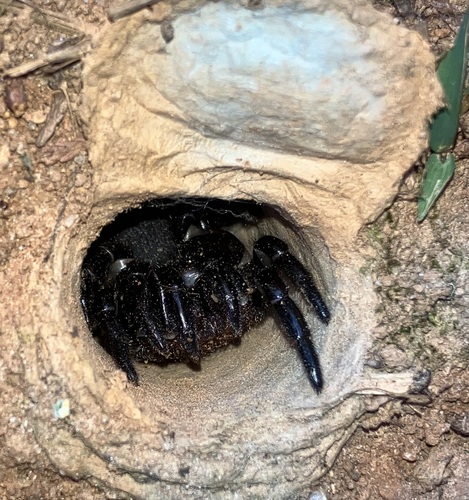
At night these spiders open the door, and layout short strands of silk in lines in several directions from the burrow. They retreat just inside the entrance and wait for a passing critter to trip the lines. The pounce is swift, with the spider retreating into the burrow to feed.
As exotic as these spiders seem to be because they are seldom seen, they are more common than we think. Audouin’s Trapdoor Spider (Ummidia audouini) occurs throughout the southeastern U.S., and as with other seldom seen critters, are common. You and I just didn’t know that they were there. Another reason to keep your eyes open every time you take a walk in nature. You never know what kind of cool critter you will see.
Hope to see you in our great outdoors!
Photo of male Audouin’s Trapdoor Spider courtesy of Curtis Makamson
Photo of Audouin’s Trapdoor Spider in burrow by Ken Kneidel (iNaturalist.org – no rights reserved CCO)
