



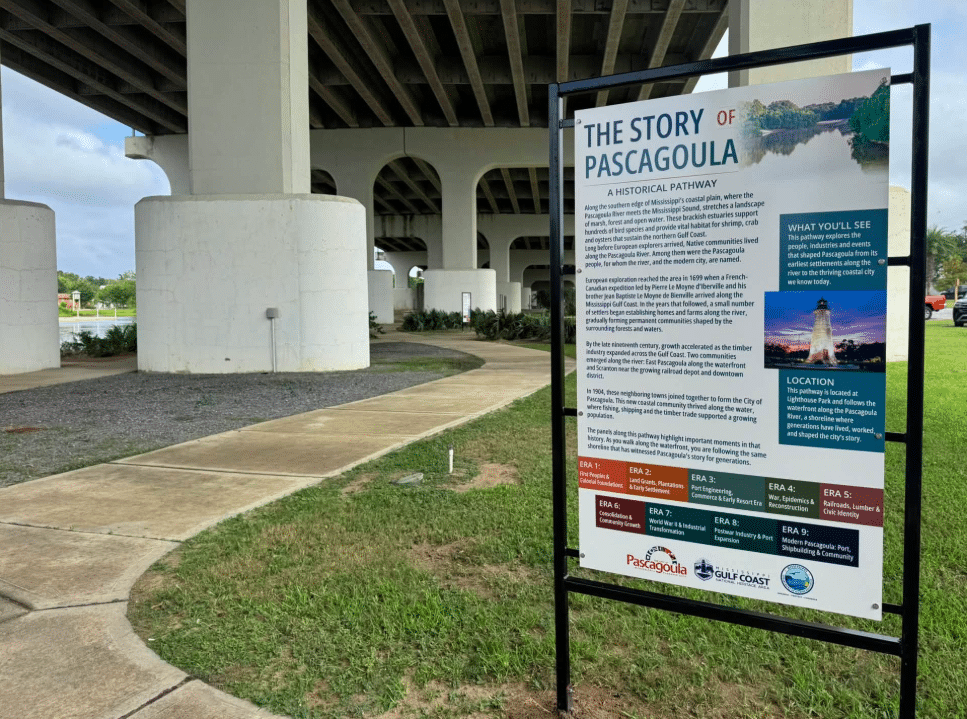
A new historical pathway at Lighthouse Park is taking visitors through nine eras of Pascagoula’s history as the city works to preserve its past amid continued growth.
The Story of Pascagoula replaces an older historical pathway whose signs had deteriorated over the years. Many of those signs directed visitors to historic homes and buildings that were either privately owned or no longer there.
The new pathway begins with the area’s First Peoples and traces Pascagoula’s history through war, railroads, shipbuilding and the industrial growth that helped shape the city.
Community Relations Director Lindsay Mitchell said Pascagoula has experienced greater growth in recent years, but preserving the community’s past remains important as the city looks toward its future. She said many Pascagoula families have lived in the area for generations.
“We thought that it was really important to remember where we came from,” Mitchell said. “We wanted to pay homage to their story and just make sure that we continuously remember how we got here today.”
Mitchell said redesigning the pathway allowed the city to move beyond individual buildings and tell a much larger story.
The new signs include historical photographs, maps and documents while breaking down Pascagoula’s development into nine eras. Mitchell worked with members of the city’s Historic Preservation Commission to research the history before writing and designing the signs.
The pathway was funded through a Mississippi Gulf Coast National Heritage Area grant that also encompassed work on the city’s Blueways project. Mitchell said the grant originally included $80,000 in total funding, with the city responsible for half and the other half funded through the Mississippi Department of Marine Resources and Mississippi Gulf Coast National Heritage Area. She said the city did not come close to spending the full amount and did not have a final cost available.
Lighthouse Park was chosen because much of Pascagoula’s history has been shaped by the water. The city sits where the Pascagoula River meets the Mississippi Sound, and the park already had an established walkway that could be used for the project.
Mitchell said even longtime residents may discover pieces of their community’s history they did not know.
“Some people know this history, but I think there’s a lot of interesting facts and stories that are inside of it that people often overlook or they didn’t know,” Mitchell said.
For Mitchell, preserving those stories becomes even more important as Pascagoula develops.
“We are a small town, but we are really at the center of so much,” Mitchell said. “We are responsible for a lot of things that affect our entire country.”
