



It’s pollinator season across the great state of Mississippi where bees are buzzing, butterflies are fluttering, and late summer and early fall gardens are starting to bloom. Without pollinators, plants would not be able to produce seeds, so it is time to celebrate them.
Pollinators, including bees, butterflies, birds, bats and other animals, transfer pollen from the male parts of a flower to the female parts of a flower. This enables plants to produce seeds and fruit. Each year, the University of Georgia hosts the Great Southeast Pollinator Census, and this year, Mississippi is officially part of the count.
Kaylin Bruening, an extension program assistant with the Mississippi State University Coastal Research and Extension Center and the state coordinator for the Great Pollinator Count, is encouraging Mississippians to join in the census.
“We want to enter our first census year with strong numbers while also helping support science in the magnolia state,” Ms. Bruening said. “This is a great opportunity for anyone of any background who wants to contribute to protecting local pollinators, and can even be good for students to gain a few service hours.”
The three main goals of the project are to create sustainable pollinator habitats, to increase the entomological literacy of citizens, and to generate useful data about pollinator populations.
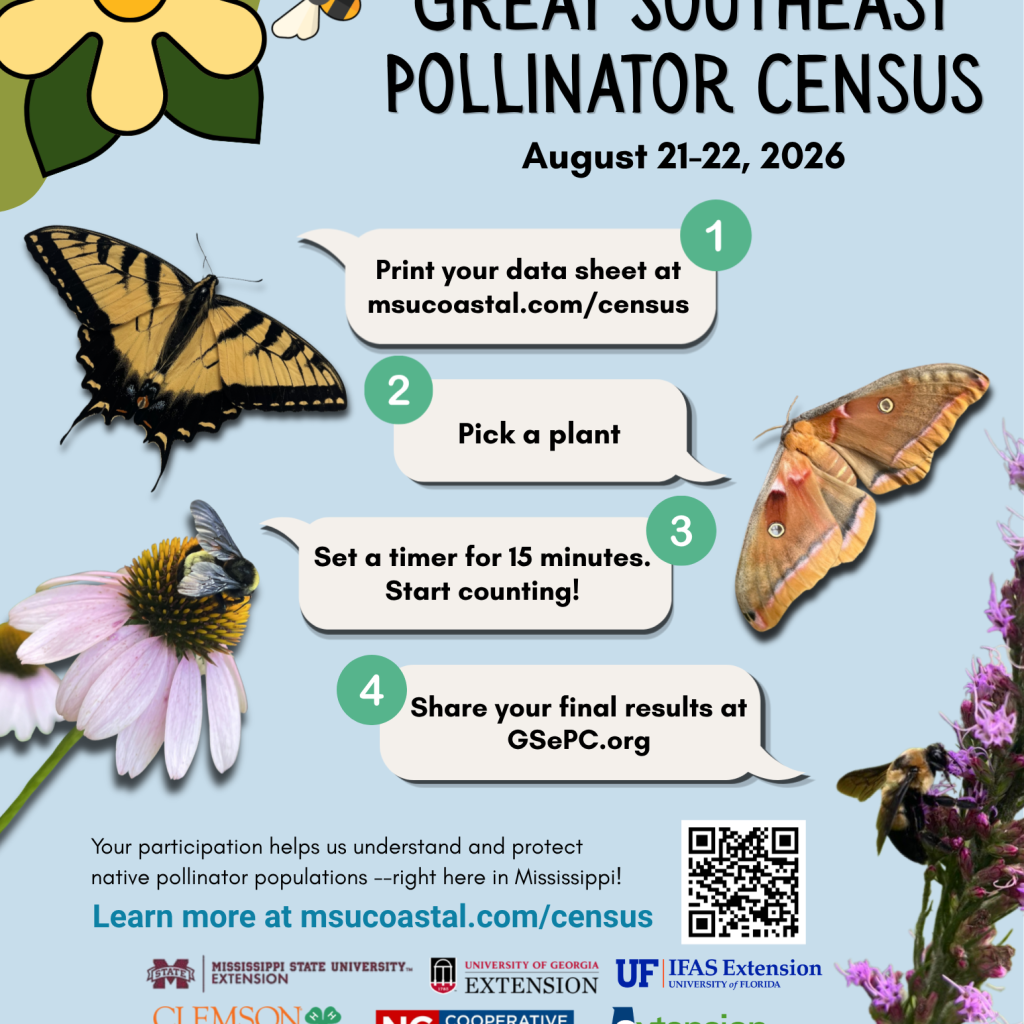
Happening August 21-22, this regional citizen science project takes 15 minutes of observation and can be completed alone or with a community group or at a business. This is a great opportunity for anyone of any background who wants to contribute to protecting local pollinators.
“The Great Southeast Pollinator Census is a regional collaborative effort that was started by Georgia Extension and now spans across 6 states,” Ms. Bruening said. “2026 is Mississippi’s first time officially participating, so my goal as State Coordinator is to get as many people as possible out there counting during the census weekend. While the data itself is useful, there’s a lot of benefit to just getting people outside to sit and notice what’s happening in the natural world around them. People are more likely to protect what they notice, and our pollinators need protection now more than ever.”
The census is designed for people living in Georgia, South Carolina, North Carolina, Florida, Alabama, and Mississippi. School groups, gardeners, families and individuals are encouraged to participate with the project. No entomology experience is needed! Participants only need to identify basic insects in the following categories:
- Bumble bees
- Carpenter bees
- Honey bees
- Small bees
- Wasps
- Flies
- Butterflies/Moths
- Other Insects
MSU has provided the resources to get started with a link to the data collection form HERE. Easy enough. First, find a pollinator plant that shows insect activity for counting. Then, count and identify the insects that land on the flowers of that plant for a 15-minute time span. Afterward, add this count to the pop-up on the GSePC.org website to make sure your counts are included in the database.
Pollinator-friendly plants include the following:
- Black-eyed Susan
- Butterfly milkweed
- Blue giant hyssop
- Raydon’s favorite aster
- Purple coneflower
- Dwarf tickseed
- Catmint
The Great Southeast Pollinator Census began in 2019 in Georgia. That inaugural event engaged 4,698 citizens scientists who documented over 131,000 insect visits. Now it is time for Mississippi residents to be part of the history-making science census.
This is a great activity for schools, and lesson plans and ideas for teachers can be found in educator resources on the website. Businesses are also welcome to participate with employees or patrons. Some companies encourage employees to count as part of the company outreach while other businesses, like restaurants and breweries, make an event of the count, asking their clients to join. And, as long as the count is between August 21 and 22, participants may enter data for multiple counts.
To learn more about this citizen science activity, visit the official website at GSePC.org for great community and classroom resources or email Ms. Bruening at [email protected].
