



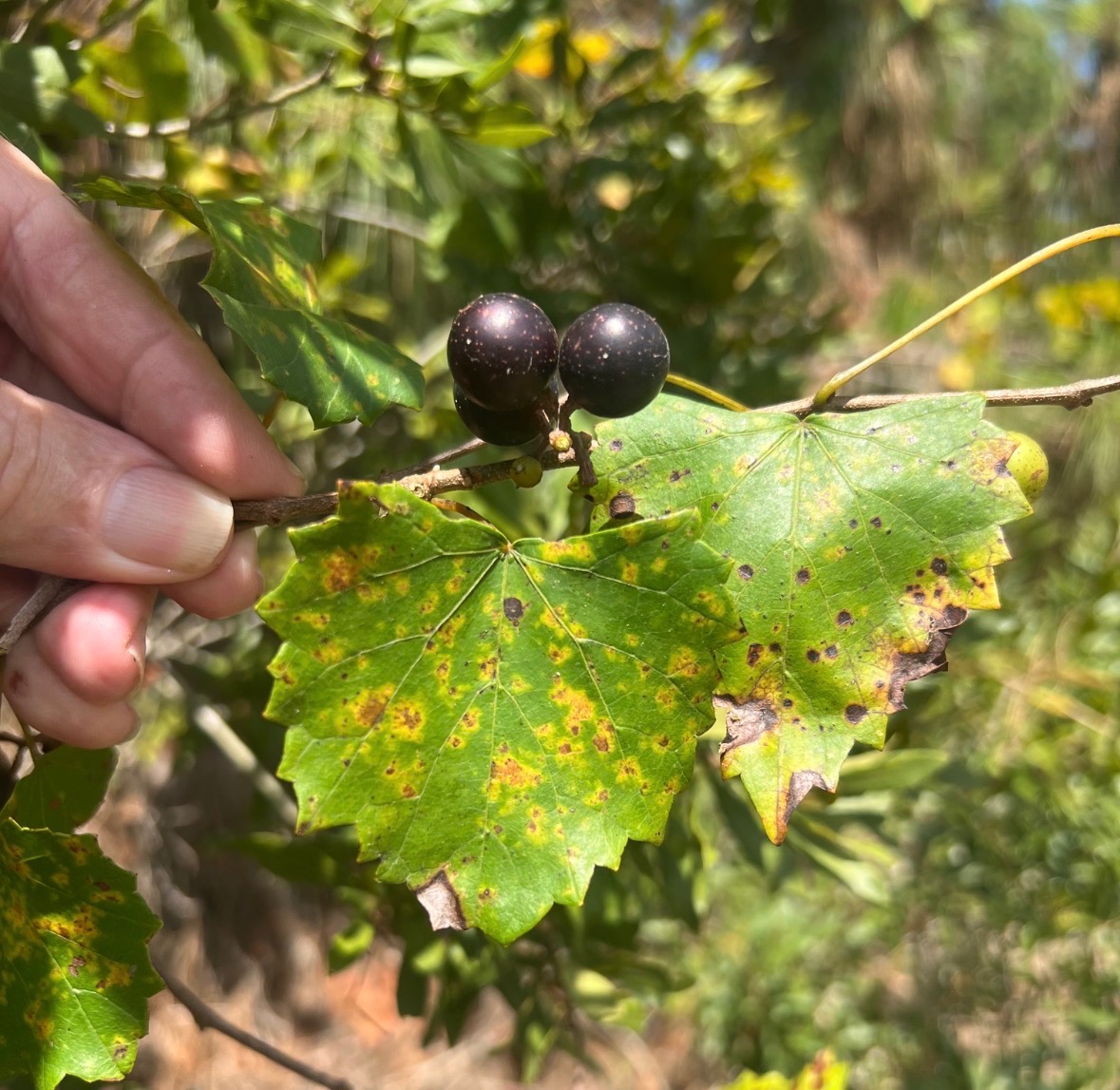
I love to forage for wild fruit. I love to eat them right off the plant. But if the pickings are plentiful, I am just as apt to collect what I can to make jelly. And late summer is prime time to collect a number of my favorites, including Muscadine (Vitis rotundifolia), the most common of seven species in the southeast. The taste is out of this world.
The challenge of locating and collecting these delightful balls of yumminess is threefold. First of all, all species of native grapes are dioecious – that is, separate male and female plants. Now, on occasion you might find a polygamodioecious plant. Yes, that is a fifty-cent technical name for a plant with monoecious and bisexual flowers. But don’t count on it.
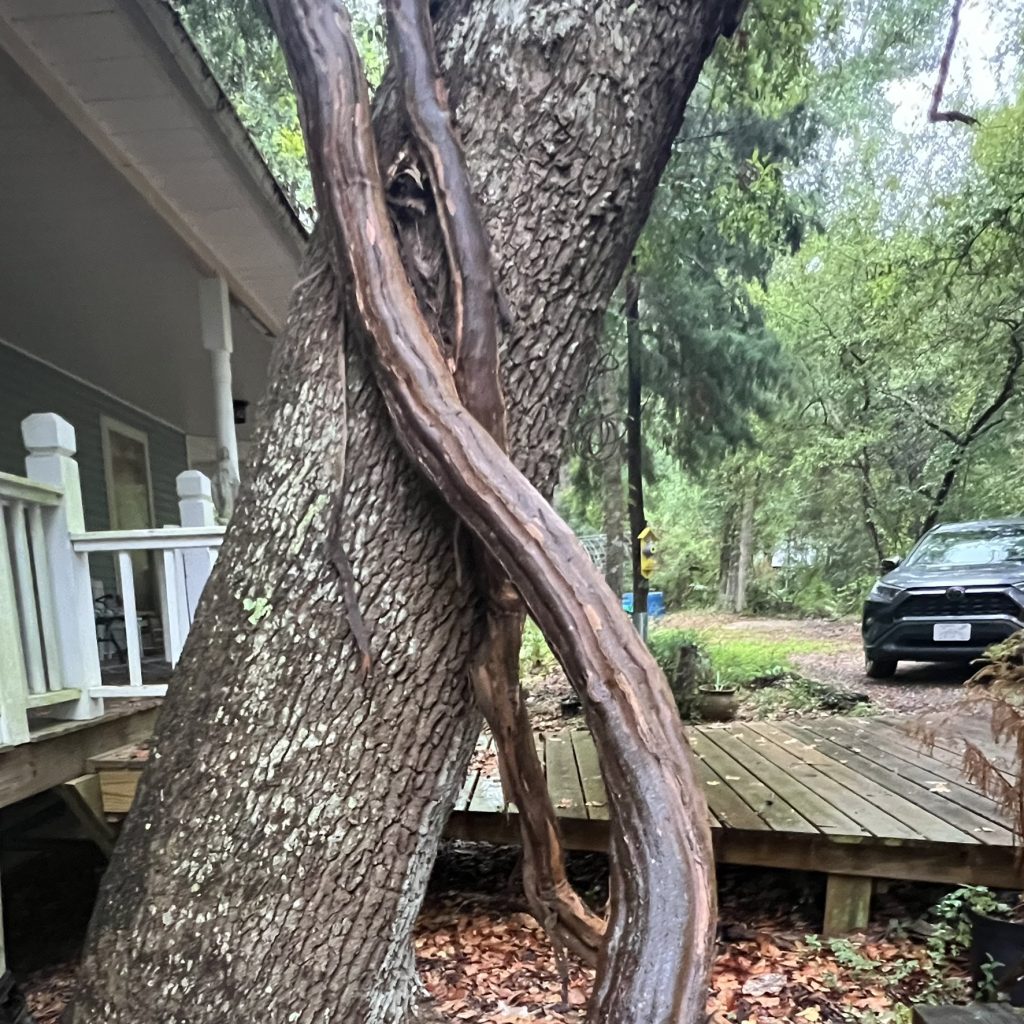
This is very sad for those of us that only have male plants in our woodlands, like me! The large male Muscadine that graces our old Live Oak is male. And it seems that from the literature about native grapes, the majority of plants in our woodlands are males. Bummer.

Second of all, as with most lianas (vines), flowers and fruit are located near the top of the trees upon which they grow. That is the best position for leaves and stems that support the plant. I have gazed up into the tops of many a tree admiring the abundance of fruit hanging far too high for me to reach. At my feet, are usually the hollow husk of grapes snacked upon by racoons and squirrels. Ugh!
Lastly, not every year is a great year for grapes, even if you have a female vine. This is often the case for many plants that have high yields of fruit one year, with less the following year. So, it is exciting to be in a year of plenty for muscadine so I can collect excess fruit for jelly.
But if the first three challenges are not enough, there is the chore of waiting patiently for enough of the fruit on the vine to ripen and pick. Fruit do not ripen all at once. And when they do for Muscadine, patience is also required to reach along the vine and pick as many of the small clusters of fruit as you can.
Unlike commercial grapes and some native grapes, Muscadine fruit grow in small clusters of 3-6 grapes and not in the long clusters that you see in stores. Unless you have a vine on a trellis, you spend most of your time reaching into the shrub upon which the vine grows, and pulling the fruit off the vine, without dropping any! The trick is to not be in a hurry. The rewards are worth it.
As for the jelly itself, any basic recipe will work. My recipe uses three cups of juice, four cups of sugar, and a packet of pectin. If you want a challenge, you can leave out the pectin, as there are natural levels of pectin in the skin of Muscadines that end up in the juice. It just means you have to simmer your jelly longer to get to the set point.
But the key to great tasting Muscadine jelly is to use as little water as possible when rendering the juice. I add just enough water to the fruit (a cup for every three pounds of fruit) to start heating them in the pot. Strong juice makes strong jelly.
So, get out there and find you a female Muscadine vine and enjoy.
Hope to see you in our great outdoors!
*Photos by Dr. Mark LaSalle
