


Skip to content
Close Menu

    Subscribe to Updates

    Get the latest creative news from FooBar about art, design and business.

    Most Viewed

    The Old Farmer’s Almanac Has Spoken on Mississippi’s Fall Forecast

    July 25, 2025

    Old Sayings Say It Best

    May 22, 2024

    Actor Jeremy London Calls Mississippi Home

    August 1, 2024

    The Julep Room: A Hole in the Wall with History

    January 8, 2024
    Facebook X (Twitter) Instagram
    Wednesday, June 24, 2026
    Trending
    • Face the Music(Fest): MSU Summer Scholars Take Stage June 26, 27
    • Jump On Over to the Pratt Community Froglevel Festival
    • HealthOne Facility to Expand Care Access in Picayune
    • Mississippi Main Street Announces 2026 Statewide Award Winners
    • Obstacles are Only Opportunities to Shaudell Brooks
    Facebook X (Twitter) Instagram YouTube TikTok
    Login
    Our Mississippi HomeOur Mississippi Home
    • Living

      More Than Milk: The Delicious Ways Mississippi Celebrates National Dairy Month

      June 22, 2026

      Dad’s Favorite Dish: The Meals That Taste Like Home

      June 21, 2026

      The Wisdom of Dad: Lessons That Last a Lifetime

      June 20, 2026

      Orchids Bring Beauty and Personality Inside

      June 18, 2026

      “Mama, I’m Bored” and Other Sounds of Summer

      June 16, 2026
    • Arts / Culture

      Face the Music(Fest): MSU Summer Scholars Take Stage June 26, 27

      June 24, 2026

      Local MSU, Summer Scholars Alum Gives Back to June Camp

      June 18, 2026

      Local Couple Bringing Community Arts Center to Lumberton

      June 10, 2026

      Fisheye Film Festival Launches in Ocean Springs

      June 9, 2026

      MSU Wins 5 Prestigious Southeast Emmys

      June 8, 2026
    • Entertainment

      Jump On Over to the Pratt Community Froglevel Festival

      June 24, 2026

      Roundabout Oxford RV and Water Park Resort Has Become a Destination All Its Own

      June 15, 2026

      The Mississippi Pickle Fest Is Kind of a Big Dill

      June 11, 2026

      Bay Fest Celebrates Gulf Coast Creativity in Bay St. Louis

      May 27, 2026

      Family, Community Focus of Forrest County Boxing Event

      May 14, 2026
    • Food & Dining

      Dad’s Favorite Dish: The Meals That Taste Like Home

      June 21, 2026

      Rice Cookers: A Kitchen Favorite Around the World

      June 14, 2026

      Biscuits, Conversation, and a Biloxi Morning Tradition

      May 24, 2026

      A Coastline Full of Flavor: Where to Eat Along Mississippi’s Gulf Coast

      April 28, 2026

      Sip, Stroll, and Stay Awhile in Ocean Springs

      April 8, 2026
    • Environment

      Mississippi to Help Expand U.S. Seafood Production

      June 19, 2026

      Orchids Bring Beauty and Personality Inside

      June 18, 2026

      Summertime Nature with Bored Kids – Make a Bee House

      June 15, 2026

      Why the Mockingbird Still Deserves Its Place as Mississippi’s State Bird

      June 13, 2026

      Southern Miss Joins Major NOAA Effort to Strengthen America’s Seafood Supply

      June 12, 2026
    • Lagniappe
      • Business
      • Sports
      • Education
      • Health & Wellness
      • OurMSVoices
      • People
    Subscribe
    Our Mississippi HomeOur Mississippi Home
    Home»Education»NASA Funds Ole Miss Studies of Planet-Forming Space Dust
    Education

    NASA Funds Ole Miss Studies of Planet-Forming Space Dust

    University of MississippiBy University of MississippiApril 24, 20264 Mins Read4 Views
    Share Facebook Twitter Pinterest LinkedIn Tumblr Reddit Telegram Email
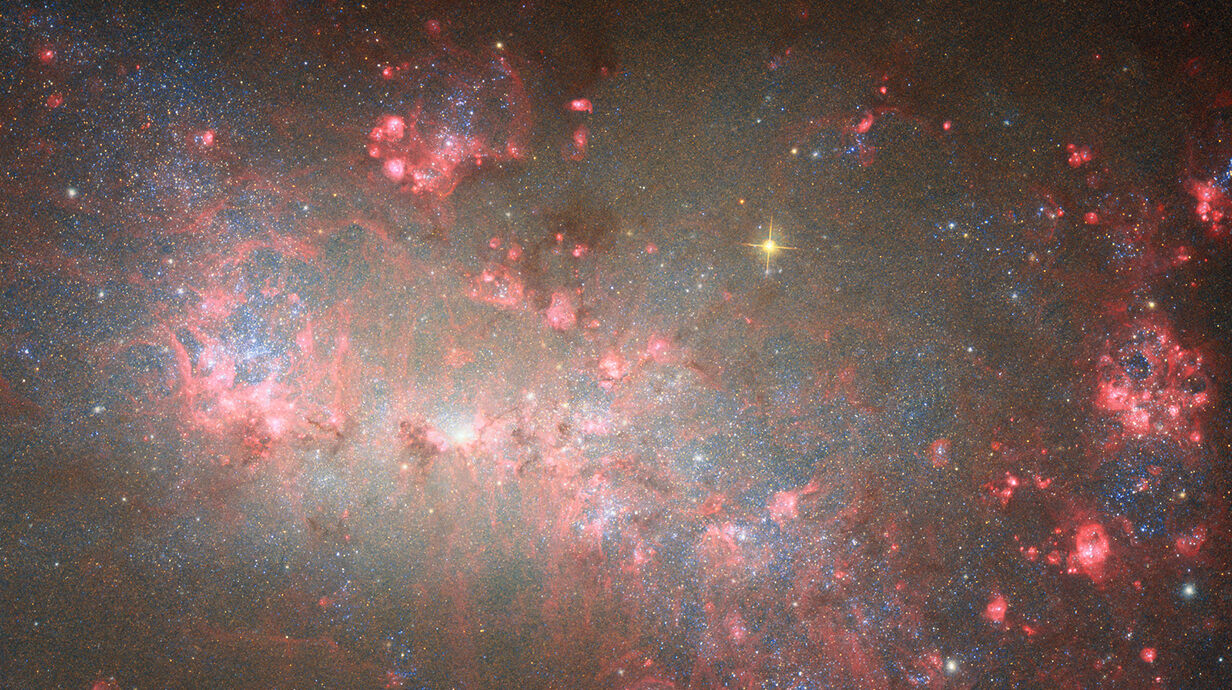
    Dust and gas fill the space between stars and galaxies and form the building blocks of all bodies in the universe. This image of the nearby galaxy NGC 4449 was captured by the NASA/ESA Hubble Space Telescope. Interstellar dust is the focus of University of Mississippi chemistry professor Ryan Forteberry's upcoming research. Photo courtesy NASA
    Share
    Facebook Twitter LinkedIn Pinterest Email Copy Link

    A University of Mississippi researcher will study the earliest stages of planet formation and the chemical abundance of the universe through two new NASA Astrophysics Research and Analysis grants.

    Ryan Fortenberry, associate professor of chemistry and biochemistry, said receiving two grants from the same program in the same cycle is rare.

    “This never happens,” he said. “These are two very different projects, but we approach them in very similar ways. The odds of them both getting funded at the same time are astronomical.”

    One grant allows Fortenberry to study a building block of all planets, rocks and moons: dust. Most rocky space bodies start their lives as collections of dust that slowly combine over billions of years to form planetary bodies. The origins of that dust, however, are more nebulous.

    Headshot of a man wearing glasses and a green plaid shirt.
    Ryan Fortenberry

    Fortenberry’s research will explore a pathway for dust formation that begins with simple molecules containing metals reacting with water. When water and gas-phase metals interact, the reaction leaves behind a small, stable cluster that is solid.

    These clusters may act as the earliest “seeds” that later grow into full dust grains, rocks, moons and planets.

    “But the thing that I’m really excited about is the reverse,” he said. “It’s the same physics. It’s the same stuff, and it’s also pertinent to NASA, but for completely different reasons, and that’s making water out of rocks. It’s the same physics; it’s just in the reverse direction.”

    Unlocking the formula to turn rocks into water could revolutionize how we think about space travel, he said.

    “The benefit of turning rocks into water is that if you have a source of hydrogen, you have as much water available to you as you have hydrogen,” he said. “Hydrogen is light. You can transport it much more easily than anything else.

    “Now we can have, effectively, a source of water wherever we need to go, whether that’s desert regions of the Earth or Mars. Any place where you have rocks, this process will hold because the fundamental chemistry is the same.”

    Through the second grant, Fortenberry and Vincent J. Esposito, assistant professor of chemistry at Chapman University, plan to develop advanced molecular models to interpret data from the James Webb Space Telescope about polycyclic aromatic hydrocarbons, complex formations of carbon that appear across the universe and on Earth.

    These molecules behave like spectral fingerprints because of how they interact with light and are thought to be common in space, especially in areas where planets or stars are forming. Definitive evidence of their makeup has been difficult to obtain because earlier telescopes did not have the resolution to distinguish subtle molecular features.

    A young man seated at a computer talks to a man and two young women in a computer lab.
    Ryan Fortenberry (left) speaks with students in his astrochemistry lab. NASA has awarded Fortenberry two grants to study how space dust forms and to explore how to break extraterrestrial rocks down to produce water. Photo by Srijita Chattopadhyay/Ole Miss Digital Imaging Services

    “When you synthesize PAHs in the laboratory and you put them out on something, they absorb all wavelengths of light,” Fortenberry said. “They’re black – they’re the reason tar is black – and they’re sticky. So, because they absorb everything and because they stick together, it’s really hard in the laboratory to figure out what their individual spectra are.

    “We know what they look like in a group, but we don’t know what they look like individually. It’s like we know what the forest looks like, but we can’t see the individual trees.”

    But with the James Webb Space Telescope’s improved resolution, astronomers can detect finer molecular details than before. Fortenberry and Esposito’s project aims to generate the quantum chemical data needed to identify those molecules and distinguish between different kinds of polycyclic aromatic hydrocarbons.

    “This gives us information about the chemical abundance of the universe,” Fortenberry said. “If we understand how much carbon is actually out there, we know how much is available for life. We know what materials could form in space.

    “More broadly, when we take chemicals – PAHs or anything else – and put them into an extreme environment like space, we have to ask new questions because they don’t behave the same ways we would expect. So, we ask new questions, we develop new science and we gain new insight.”

    This material is based on work supported by NASA grant nos. 80NSSC24M0036 and 80NSSC24M0132.

    Previous ArticleHelp Create a Bird-Friendly Oasis in Mississippi
    Next Article More Than a Diagnosis: David Cameron’s Ride Through Resilience
    University of Mississippi

    Founded in 1848, the University of Mississippi, affectionately known to alumni, students and friends as Ole Miss, is Mississippi's flagship university. Included in the elite group of R-1: Doctoral Universities - Highest Research Activity by the Carnegie Classification, it has a long history of producing leaders in public service, academics and business. With more than 24,000 students, Ole Miss is the state's largest university and is ranked among the nation's fastest-growing institutions.

    Related Posts

    Arts / Culture

    Face the Music(Fest): MSU Summer Scholars Take Stage June 26, 27

    June 24, 2026
    Education

    Mississippi to Help Expand U.S. Seafood Production

    June 19, 2026
    Education

    Orchids Bring Beauty and Personality Inside

    June 18, 2026
    Add A Comment

    Comments are closed.

    Stay In Touch
    • Facebook
    • YouTube
    • TikTok
    • Twitter
    • Instagram

    Subscribe to Updates

    Get the latest good news happening in Mississippi!

    Most Popular

    The Old Farmer’s Almanac Has Spoken on Mississippi’s Fall Forecast

    July 25, 20258K Views

    Old Sayings Say It Best

    May 22, 20248K Views

    Actor Jeremy London Calls Mississippi Home

    August 1, 20247K Views
    Our Picks

    Face the Music(Fest): MSU Summer Scholars Take Stage June 26, 27

    June 24, 2026

    Jump On Over to the Pratt Community Froglevel Festival

    June 24, 2026

    HealthOne Facility to Expand Care Access in Picayune

    June 23, 2026

    Subscribe to Updates

    Get the latest good news from Our Mississippi Home.

    Our Mississippi Home
    Facebook X (Twitter) Instagram YouTube TikTok RSS
    • About OurMSHome
    • Advertise
    • Community Partners
    • Privacy Policy
    • Guidelines
    • Terms
    © 2026 Our Mississippi Home. Designed by Know_Name.

    Type above and press Enter to search. Press Esc to cancel.

    Ad Blocker Enabled!
    Ad Blocker Enabled!
    Our website is made possible by displaying online advertisements to our visitors. Please support us by disabling your Ad Blocker.

    Sign In or Register

    Welcome Back!

    Login to your account below.

    Lost password?