


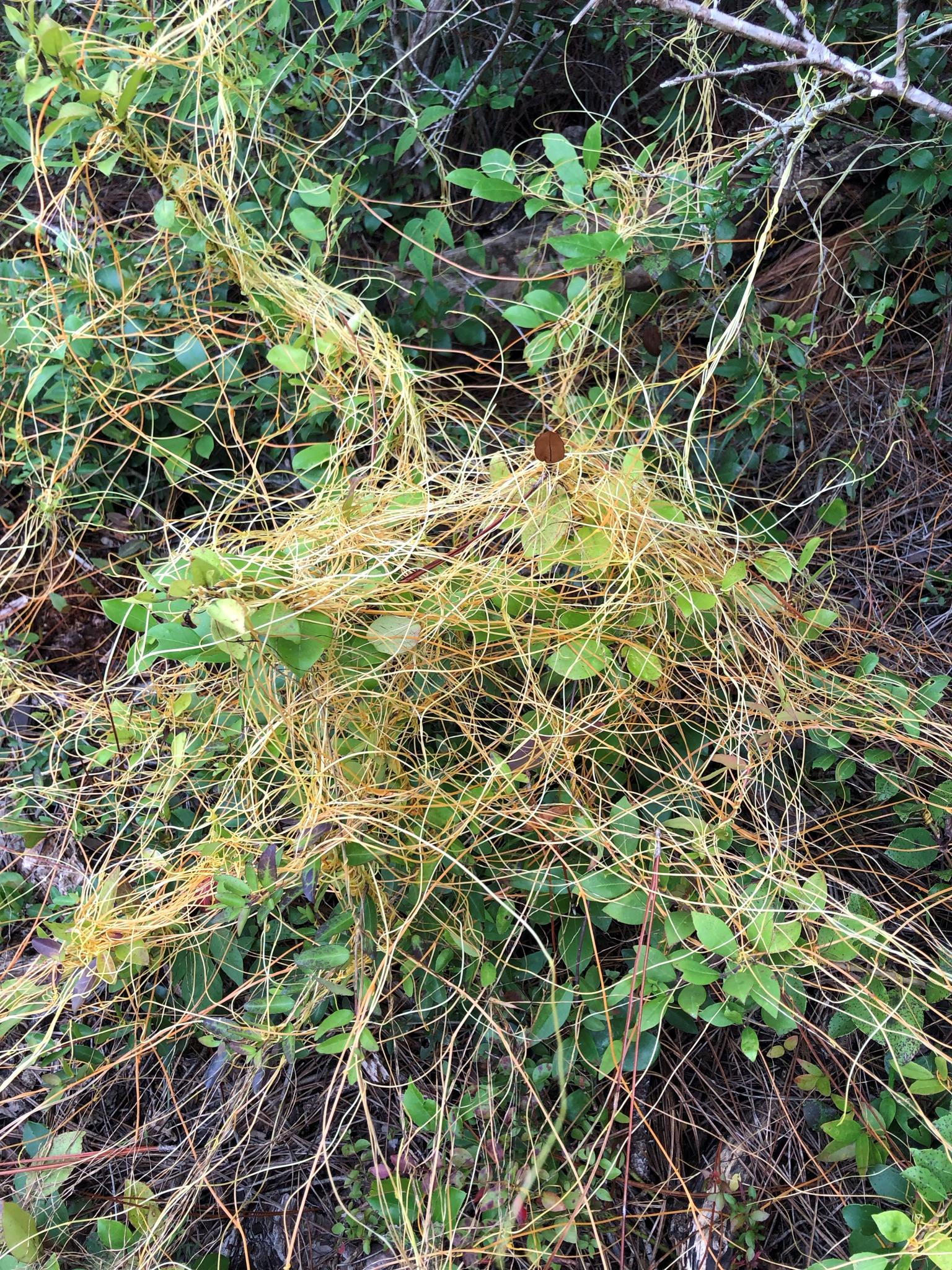
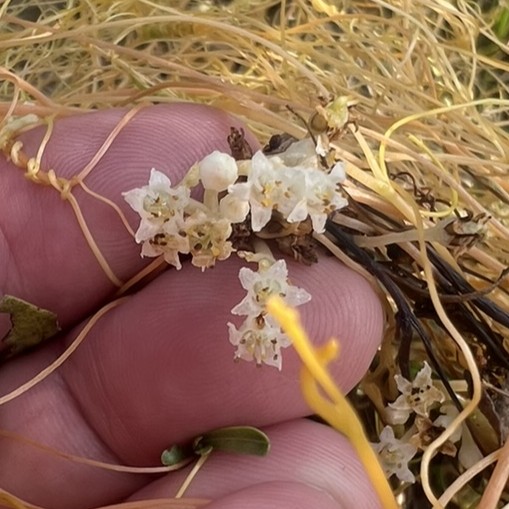
What looks like a mass of yellow spaghetti draped over a plant is, well, another plant – Dodder (Cuscuta spp). It is in fact a parasitic vine that is draining the life out of its host. The name dodder is largely thought to be derived from the German word dotter, referring to egg yolk, a reference that fits it well. But if you look close, this vine has flowers, cute ones at that, and an interesting and successful way of life.
Being a stringy parasitic vine is apparently a great lifestyle, as there are estimated to be 100 and 150 species worldwide. Fifty-five species are recorded from Alabama and adjacent states, including a few non-native species. Reflecting this wide range of occurrence are the many cultural names for these plants, including Love-Vine, Angel’s Hair, Tangle-Gut, Strangle-Vine, Devil’s-Gut, and Witches’-Shoelaces. And yes, many cultures used this plant for a variety of medicinal and cultural purposes.
But if you look past the plant’s diabolical nature as a parasite, you have to admire its design. The group derives everything it needs from its host plant. From tiny seeds that fall to the ground, a tiny plant grows upwards, hopefully adjacent to a host plant (there are many that will fit the bill). If it does not, the tiny plant dies for lack of energy.
Once in contact with a host, the vine produces two types of specialized stems called haustoria that penetrate the host’s tissue, one tapping into the xylem, the water carrying vascular system, and the other into the phloem that carries sugars. It robs the host plant of both resources and often weakens or kills the plant. But as an annual plant (living only one season), its life strategy is all about producing flowers and seeds for the next generation.
But for most of us, these plants are considered pests, attacking a wide range of agricultural plants. It can also be difficult to treat once established. Chemical treatment is ill advised, as any chemical that you might be able to apply to the vine itself will end up in the host plant through the haustoria that connects the two. If removal is a goal, the best approach is to pull the vine from the host plant early and before it blooms and sets seeds.
But in most cases, the extent of Dodder is small and just part of the ecosystem around us. Overall, it is really just a curious splash of yellow spaghetti along the roadside. And yet, given the 100s of species of Dodder in the world, it has a good recipe for success.
Hope to see you in our great outdoors!
